
Petarium Daily · 11 October 2026 · 14 min read
How to Care for a Rabbit: A Complete British Guide to Welfare and Health
Caring for a rabbit requires a high-fibre diet consisting of at least 85% fresh feeding hay, secure predator-proof housing with permanent access to an exercise run, and companionship from a neutered fellow rabbit. Because rabbits hide illness instinctively, daily monitoring of their feeding patterns, droppings, and behaviour is vital to catch life-threatening issues such as gut stasis early.
Key takeaways
- A healthy diet consists of at least 85% good quality hay or fresh grass, 10% leafy greens, and only 5% plain extruded pellets.
- Rabbits must never live in a cramped traditional hutch; modern welfare standards require an unbroken footprint of at least 3m x 2m x 1m.
- Rabbits are obligate social animals and should almost always live with a neutered, compatible companion of their own species.
- Loss of appetite or lack of droppings for more than 6 to 12 hours is a life-threatening medical emergency known as gut stasis.
- Annual vaccinations against Myxomatosis, RVHD1, and RVHD2 are essential for all pet rabbits, including those kept exclusively indoors.
Learning how to care for a rabbit properly begins with understanding that domestic rabbits (Oryctolagus cuniculus) are complex, sensitive herbivores with specialised welfare needs. Far from being the low-maintenance, starter children's pets that popular culture once portrayed, rabbits demand as much commitment, veterinary supervision, and thoughtful daily attention as a dog or a cat.
In the United Kingdom, leading animal welfare charities such as the Rabbit Welfare Association & Fund (RWAF), the RSPCA, and the PDSA have established clear, evidence-based standards for companion rabbit care. Meeting these standards involves feeding a fibre-heavy diet, providing enormous living spaces, protecting their respiratory systems, and honouring their status as obligate social creatures who depend on the companionship of their own kind.
What Do Rabbits Need to Eat Every Day?
The foundation of all rabbit health is dietary fibre. A rabbit's gastrointestinal tract and open-rooted, constantly growing teeth evolved to process tough, fibrous grasses throughout the day. Getting this balance right prevents the two most common and devastating domestic rabbit diseases: painful dental spurs and gastrointestinal hypomotility.
The Proportions: Hay, Fresh Greens, and Pellets
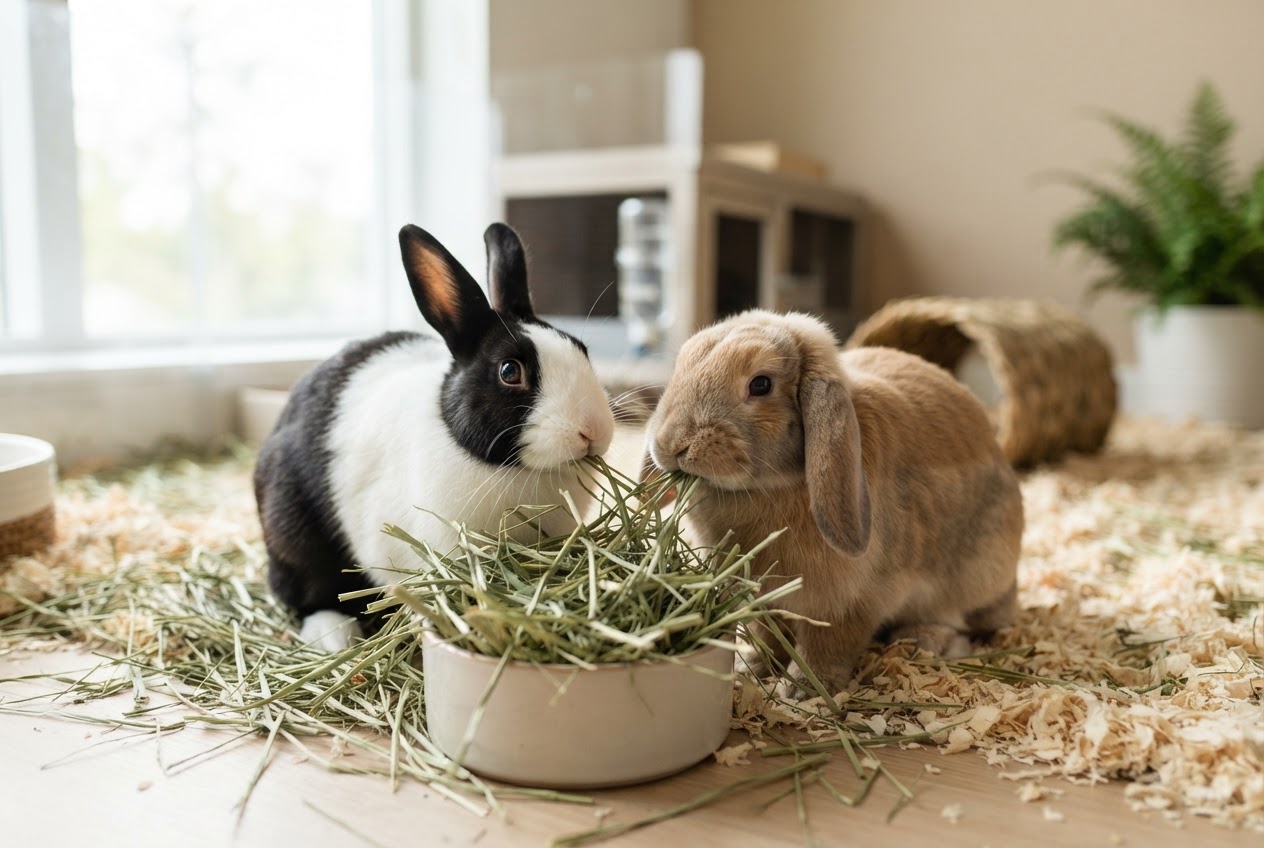
Mainstream veterinary consensus divides a rabbit's daily food intake into three strict proportions. Hay must always represent the vast majority of what enters their digestive system, as detailed in our guide to rabbit nutrition:
- 85% to 90% Fresh Feeding Hay or Grass: Unrestricted, continuous access to dust-extracted meadow hay, timothy hay, or orchard grass. A rabbit should eat a bundle of hay equal to their own body size every single day.
- 10% Rabbit-Safe Leafy Greens: A daily rotation of washed, dark green vegetables and fresh culinary herbs, offering hydration, micronutrients, and mental enrichment.
- 5% Extruded Pellets: A measured, strictly limited portion of uniform, timothy-based pellets (approximately one level tablespoon per kilogram of ideal adult body weight daily).
Ideal Daily Dietary Composition for an Adult Rabbit
Never feed rabbits cereal 'muesli' mixes containing grains, seeds, and colourful biscuits. Decades of veterinary studies have proved that rabbits selectively feed on the starch-rich bits, leaving behind essential calcium and fibre. This selective feeding causes fatal dental abscesses, obesity, and life-threatening gut disorders. Use only uniform, extruded rabbit pellets.
| Safe Daily Greens & Herbs | Occasional High-Sugar Treats | Toxic or Dangerous Foods (Never Feed) |
|---|---|---|
| Romaine lettuce, flat-leaf parsley, coriander, mint, dill, basil | Carrot slices (1 teaspoon weekly), apple slices without seeds | Avocado, onion, garlic, leeks, shallots, chives |
| Spring greens, kale, cavolo nero, dandelion leaves, plantain | Fresh blueberries, raspberries, strawberries (small piece) | Chocolate, human confectionery, processed cereal bars, biscuits |
| Celery leaves, fennel tops, carrot tops, watercress, rocket | Banana slices (small coin-sized piece as a rare reward) | Iceberg lettuce (contains lactucarium), potato, tomato leaves, rhubarb |
Fresh Drinking Water: Bowls Versus Bottles
Rabbits drink surprisingly large quantities of water; a medium-sized rabbit can drink as much water in a day as a small dog. Scientific research into rabbit drinking behaviours demonstrates that rabbits drink far more willingly and efficiently from an open, heavy ceramic bowl than from a sipper bottle with a ball valve. Sipper bottles can jam, freeze rapidly in cold weather, and frustrate the animal's natural lap-drinking posture. Provide a heavy, tip-proof ceramic bowl, refreshed with cool tap water twice a day.
How Much Living Space Does a Rabbit Truly Require?
The traditional image of a pet rabbit confined to a small wooden hutch at the bottom of the garden is cruel, outdated, and unacceptable under modern welfare science. Rabbits are active, athletic animals built to sprint, leap, binky, and forage over large territories. Keeping them in cramped cages causes skeletal deformities, muscle wasting, obesity, behavioural depression, and intense frustration.
Whether you choose to keep your pets indoors or outdoors, their living quarters must be predator-proof, escape-proof, and richly furnished to encourage species-specific behaviours like digging, perching, and foraging. Explore our dedicated overview on house rabbit care for tailored home setups.
Indoor Rabbit Housing Setup
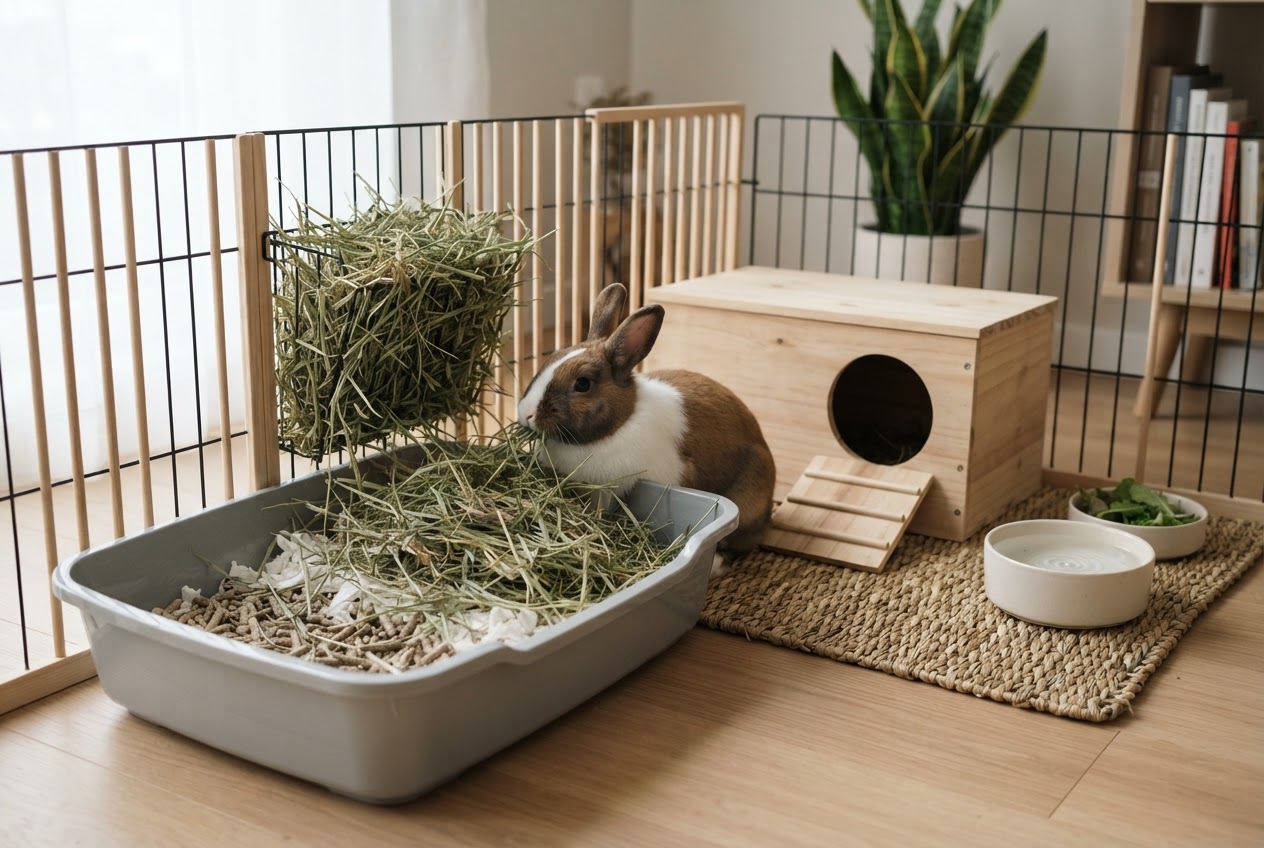
- Base Housing: An open-topped modular metal exercise pen (puppy pen) or a dedicated rabbit-proof room, floored with non-slip rugs, cotton mats, or vinyl with foam mats underneath.
- Rabbit-Proofing: Cover all electrical cables with hard plastic conduit tubing, install skirting board protectors, and remove toxic houseplants (such as lilies, ivy, and philodendrons) entirely from their reach.
- Hiding Places: At least two sturdy cardboard boxes or wooden tunnels with two separate entrances so a rabbit never feels trapped.
- Litter Trays: Large, shallow, low-entry storage boxes lined with dust-free recycled paper pellets or wood pellets, topped with a deep layer of meadow hay.
Outdoor Rabbit Housing Setup
If housing rabbits outdoors, a standard two-storey hutch alone is completely insufficient. The enclosure must consist of an insulated, dry, draft-free wooden shed or Wendy house permanently attached to a walk-in, heavily reinforced run. Use 16-gauge, 1.25cm welded mesh (never chicken wire, which foxes and stoats easily chew through) and install paving slabs or underground mesh beneath the run perimeter to prevent digging predators from entering and your rabbits from tunnelling out.
Outdoor rabbits are vulnerable to extreme weather conditions. Make sure to consult our guide on keeping outdoor rabbits safe and warm in winter, as well as our seasonal advice on summer safety for rabbits to protect against deadly heatstroke.
Why Must Rabbits Be Kept in Bonded Pairs?
Wild European rabbits live in extensive, highly cooperative social warrens. Solitary rabbits suffer from chronic stress, boredom, and psychological distress. While human affection is valuable, a human cannot groom a rabbit's ears for hours, sleep alongside them in a tight huddle, or provide the continuous reassurance that an alert companion offers against imaginary predators.
The most reliable and stable social grouping is one neutered male and one spayed female of similar size and temperament. Learn why animal rescues advocate this in our guide to adopting rabbits in bonded pairs. When introducing unfamiliar rabbits, you must follow the structured steps described in our rabbit bonding guide.
Step-by-Step: The Essential Daily Care Routine
Consistency is critical for rabbit welfare. Rabbits are crepuscular, meaning they are naturally most active at dawn and dusk. Establishing an orderly morning and evening routine ensures their physical needs are met and allows you to spot subtle health changes immediately.
- 1
Morning Dropping and Appetite Assessment
Check their litter tray and resting areas before touching food dishes. Confirm there is a generous pile of normal, round, dry, crumbly faecal pellets. Ensure all cecotropes (grape-like nutrient-rich droppings) have been naturally consumed by the rabbit.
- 2
Fresh Water and Hay Replenishment
Empty, scrub, and refill water bowls with clean water. Empty the hay rack and discard soiled, damp hay. Load the rack and litter boxes with sweet-smelling, green feeding hay. A rabbit will naturally graze while sitting in their litter tray.
- 3
Pellet Rationing and Physical Welfare Check
Distribute their measured tablespoon of pellets. Observe that both rabbits sprint toward their food enthusiastically. A rabbit that hesitates or ignores pellets is showing a primary warning sign of pain or gut stasis.
- 4
Midday Spot Cleaning and Enrichment
Scoop out wet corners in the litter tray, replacing damp paper substrate with dry hay. Provide foraging enrichment, such as apple-wood chew sticks, dried dandelion roots, or cardboard boxes stuffed with forage herbs.
- 5
Evening Greens and Rear-End Inspection
Feed their rotation of fresh leafy greens and culinary herbs. Perform a rapid hands-on visual check of their hindquarters to ensure the fur is clean, completely dry, and free from soft faeces or wet urine stains.
How Should You Handle and Groom a Pet Rabbit?
Most rabbits intensely dislike being picked up. As prey animals, being lifted off the ground triggers an instinctive terror of being seized by an aerial predator such as a buzzard or fox. Forcing cuddles can lead to panic, severe kicks, and potentially catastrophic spinal fractures.
Gentle Handling Principles
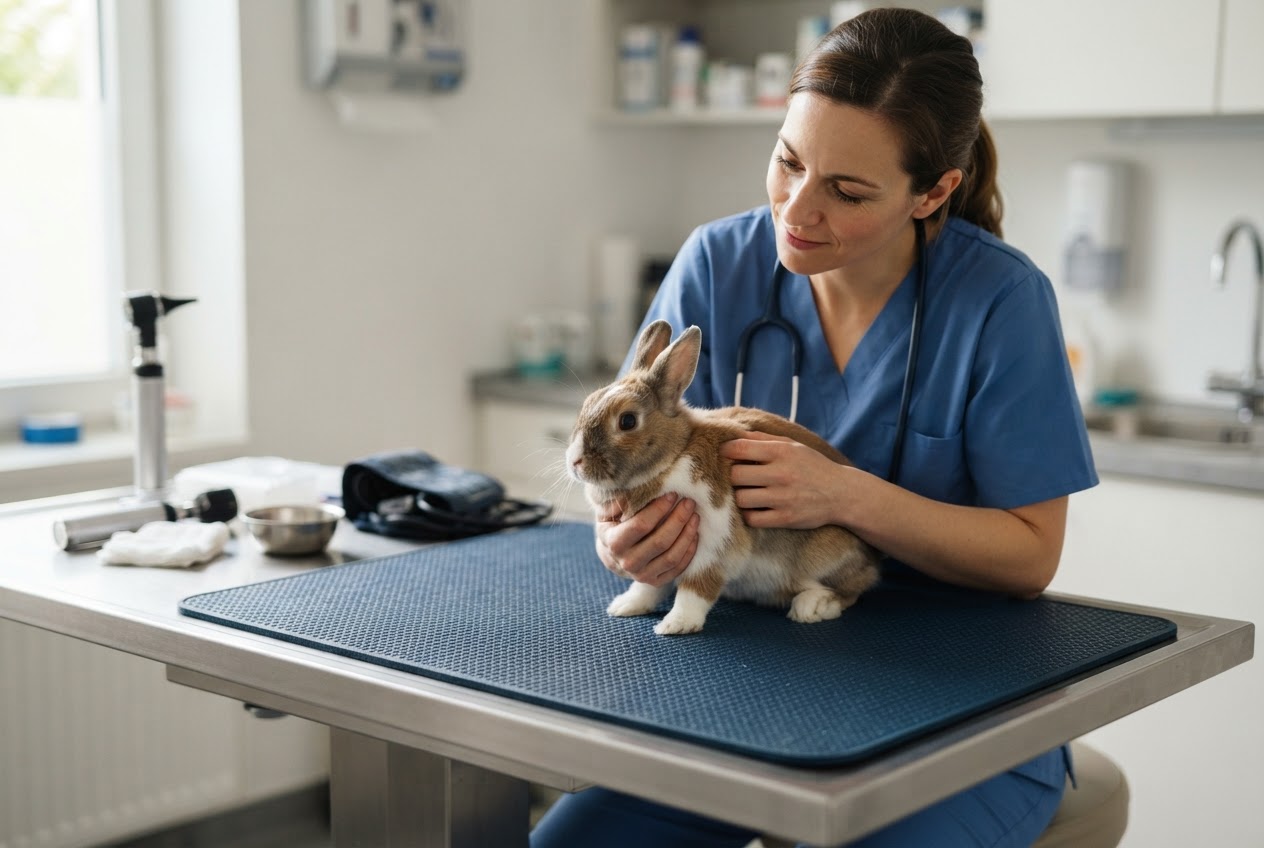
Interact with your rabbit at ground level. Sit quietly on the floor with a few sprigs of herbs, allowing your rabbits to approach, climb on your lap, and investigate you voluntarily. When lifting is medically necessary or required for grooming:
- Never pick up a rabbit by their ears or the scruff of their neck. This is extraordinarily painful and can inflict severe nerve and tissue damage.
- Place one hand firmly under their chest, supporting their front legs between your fingers.
- Immediately scoop their hindquarters with your other hand, supporting their entire lower spine and back legs securely.
- Hold them close to your chest so they feel safe and cannot kick out or leap out of your arms.
Grooming and Claw Maintenance
Rabbits shed their coats heavily every three months, with one particularly intense seasonal moult in autumn and spring. Unlike cats, rabbits cannot vomit; any hair they swallow during grooming must pass through their delicate intestines. Ingested fur can mat with dehydrated food particles, forming a fatal blockage.
Brush short-haired rabbits at least twice weekly using a soft slicker or rubber grooming mitt, and brush them daily during a moult. Long-haired breeds (such as Lionheads or Angoras) require daily detangling to prevent painful felted mats. Check their claws once a month; rabbits kept indoors on soft rugs do not wear their claws naturally and require clipping with small animal nail clippers just ahead of the sensitive pink quick.
Preventive Veterinary Healthcare: Vaccines and Parasites
All companion rabbits require proactive preventive medicine managed by an experienced rabbit-friendly veterinary surgeon. Modern UK veterinary practice relies on three fundamental preventive cornerstones: full immunisation, neutering, and daily monitoring for parasite risks.
Core Vaccinations
In the UK and continental Europe, wild and domestic rabbits face three deadly viral diseases: Myxomatosis, Rabbit Viral Haemorrhagic Disease 1 (RVHD1), and Rabbit Viral Haemorrhagic Disease 2 (RVHD2). These viruses are exceptionally stable in the environment and are transmitted by biting insects (fleas, mosquitoes), bird droppings, contaminated hay, blown grass clippings, and on owners' shoes or clothing. Even strictly indoor house rabbits must be vaccinated annually with the single 3-in-1 combination vaccine starting from 5 to 7 weeks of age.
Neutering and Spaying
Neutering is not merely a tool for population control; it is an essential welfare intervention. Unspayed female rabbits face an extraordinarily high risk of uterine adenocarcinoma (uterine cancer)—veterinary studies estimate that over 70% to 80% of unspayed females develop this fatal malignancy by 4 to 5 years of age. Castration of male rabbits eliminates testicular tumours and dramatically calms hormone-driven territorial spraying, aggression, and sexual mounting. Female rabbits can usually be spayed between 4 and 6 months of age, while males are castrated as soon as the testicles descend (around 10 to 16 weeks).
Flystrike (Myiasis) Prevention
Flystrike is a horrific and often fatal condition that primarily strikes during warm weather between April and October. Greenbottle and bluebottle flies are attracted to damp fur, soiled bottoms, and wet bedding, where they lay hundreds of eggs. Within hours, these eggs hatch into flesh-eating maggots that burrow directly into the rabbit's skin and tissues. Inspect your rabbit's rear end twice a day during warm months, clean their living quarters diligently, and speak to your vet about preventative insect-growth regulator solutions applied along the spine and rump.
Recognising and Preventing Life-Threatening Gut Stasis
Gastrointestinal stasis (gut stasis) is one of the most common causes of death in pet rabbits. It is not an isolated disease in itself, but a symptom of an underlying medical issue, such as severe stress, unaddressed dental disease, dehydration, lack of dietary fibre, or visceral pain. When gut stasis occurs, the muscular contractions of the stomach and intestines slow to a complete standstill.
As gut motility halts, gas accumulates painfully in the stomach and cecum, normal bacterial flora collapses, and toxic clostridial bacteria proliferate. Without urgent veterinary intervention—including high-volume subcutaneous or intravenous fluids, multimodal pain relief, prokinetic gut-stimulant drugs, and supportive syringe feeding—the rabbit will enter irreversible hypothermic shock and die within 24 to 48 hours. Read our comprehensive emergency guide to gut stasis in rabbits to learn how to identify early warning signs.
Providing Mental Enrichment and Safe Chewing
A bored rabbit is an unhappy and destructive rabbit. In the wild, rabbits spend hours foraging, digging elaborate underground burrows, surveying surroundings, and running from natural challenges. Confined pet rabbits must have functional outlets for these hardwired evolutionary drives.
Enrichment Ideas That Actually Work
- Digging Boxes: Fill a large storage tub or high-sided cardboard box with child-safe play sand, shredded untreated paper, or soil, allowing rabbits to burrow without ruining household carpets.
- Foraging Toys: Hide fresh herbs or pellets inside natural wicker balls, unbleached cardboard toilet paper rolls packed with timothy hay, or woven grass mats.
- Safe Wood for Chewing: Provide fresh or dried branches of apple, hazel, pear, or willow. Chewing wood naturally wears down their incisors and provides tactile stimulation.
- Elevated Lookout Points: Low, stable wooden benches, cardboard castles, or steps where rabbits can hop up and survey their domain from an elevated, secure vantage point.
What Is the True Long-Term Commitment of Rabbit Care?
Before bringing rabbits into your household, you must consider their expected lifespan and lifetime veterinary expenses. A well-cared-for pet rabbit kept in safe, predator-free housing with appropriate nutrition regularly lives between 8 and 12 years, with some dwarf breeds reaching 14 years or more. To plan appropriately for their twilight years, review our guide on how long rabbits live and healthy ageing.
Rabbits require dependable ongoing financial support. In addition to initial neutering and setup enclosures, annual vaccinations, preventative flystrike spot-ons, high-grade feeding hay, litter substrates, and emergency exotic veterinary bills for dental treatments or gut stasis episodes can easily total hundreds of pounds each year. Taking out comprehensive pet insurance from a dedicated rabbit insurer is strongly advised by welfare professionals.
Frequently asked questions
Can I keep a single rabbit if I give it lots of human attention?
Welfare guidelines strongly advise against keeping a single rabbit. Rabbits are intensely social prey animals that rely on the constant reassuring company and mutual grooming of their own species 24 hours a day. While human interaction is beneficial, you cannot replace the constant companionship of a compatible, neutered partner rabbit.
How often should I clean my rabbit's living quarters?
Perform spot-cleaning daily by removing wet litter, clearing soiled corners, and replacing damp hay. Perform a thorough clean once a week by washing litter trays and sweeping pens using pet-safe, non-toxic disinfectant (such as diluted white vinegar or dedicated veterinary sanitiser). Avoid harsh pine or bleach cleaners that damage their delicate respiratory systems.
Can rabbits and guinea pigs live together in the same enclosure?
No, rabbits and guinea pigs should never live together. Rabbits are much larger and stronger; a sudden kick from powerful rabbit hind legs can easily break a guinea pig's back. Furthermore, rabbits naturally harbour the bacteria Bordetella bronchiseptica, which causes fatal respiratory disease in guinea pigs, and both species have distinct dietary needs.
Can a pet rabbit use a litter tray like a cat?
Yes, rabbits naturally choose consistent toilet corners and take well to litter training once neutered. Place a large, shallow litter tray in their preferred corner, line it with paper-based bedding (never clay clumping cat litter, which can cause fatal blockages if ingested), and pile fresh meadow hay directly on top. Rabbits graze and defecate simultaneously.
Why is my rabbit eating its own droppings?
This is completely normal and healthy. Rabbits produce two types of waste: hard, dry round faecal pellets, and soft, glistening clustered droppings called cecotropes. Cecotropes are rich in essential B vitamins, protein, and beneficial bacteria. Rabbits ingest them directly from their bottom to extract vital secondary nutrients. Do not stop this behaviour.
How can I tell if my rabbit is in pain?
Because rabbits are prey animals, they mask physical pain stoically. Signs of pain include sitting hunched up in a corner, refusing food, rapid shallow breathing, squinting or bulging eyes, reluctance to move, pressing the abdomen flat against the floor, or producing a loud, rhythmic grinding sound with their teeth (bruxism), which sounds distinct from gentle contentment purrs.
Do indoor rabbits still need annual vaccinations?
Yes, indoor rabbits absolutely require annual vaccination. Deadly viral infections such as Myxomatosis, RVHD1, and RVHD2 are easily brought indoors on shoes, clothing, blown garden materials, contaminated bags of hay, or by biting insects like fleas and mosquitoes that fly through open windows. Vaccination is vital protection.
Sources and further reading
- Rabbit Welfare Association & Fund (RWAF) Care Guidelines — rabbitwelfare.co.uk
- RSPCA Rabbit Care and Welfare Advice — rspca.org.uk
- PDSA Rabbit Housing, Health and Nutrition Guides — pdsa.org.uk
- Blue Cross Rabbit Care Advice and Health Essentials — bluecross.org.uk
- British Veterinary Association (BVA) Rabbit Welfare Position — bva.co.uk
More from Petarium Daily
- Cat Mouthing: Why Cats Gently Bite and How to Stop It
Cat mouthing occurs when a feline places its teeth lightly against skin or clothing without clamping down aggressively. This behaviour typically stems from playful arousal, petting-induced overstimulation, kitten teething, or an attempt to communicate physical boundaries.
- How to Toilet Train a Puppy in 7 Days: A Realistic Fast-Track Plan
You can establish clean toileting habits in seven days by running an intensive management schedule, taking your puppy outside every 30 to 45 minutes, and rewarding outdoor eliminations immediately. While full physiological bladder control takes several months, a structured seven-day reset dramatically reduces accidents and sets up lifelong house-training success.
- How Do Cats Communicate? Vocal, Visual, and Scent Signals
Cats communicate using a subtle, multi-layered system combining vocal sounds, body posture, facial expressions, and chemical scent marking. By understanding how feline signals work together in context, you can accurately interpret your cat's emotional state and strengthen your bond.