
Petarium Daily · 4 October 2026 · 12 min read
House Rabbit Care: The Complete Indoor Guide
House rabbit care involves providing a large, predator-safe indoor living space, a high-fibre diet dominated by feeding hay, and companionship from a neutered partner. By thoroughly rabbit-proofing your living areas and monitoring daily digestive health, indoor rabbits can thrive safely alongside your family.
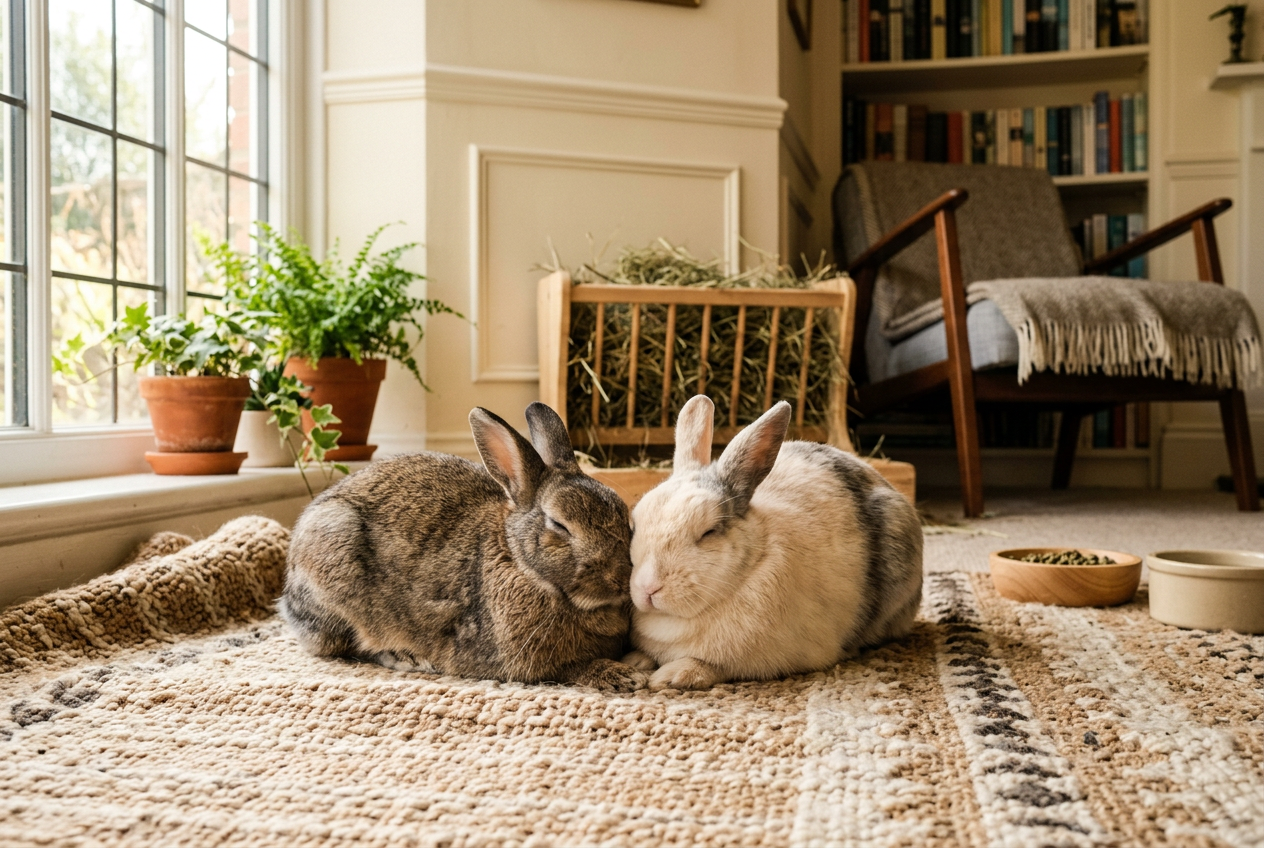
Key takeaways
- Unrestricted access to fresh feeding hay must make up at least 85% to 90% of your rabbit's daily diet.
- The Rabbit Welfare Association and Fund (RWAF) recommends a minimum enclosure size of 3m x 2m x 1m for a bonded pair.
- Rabbits are obligate social animals and should almost always live with a neutered, compatible companion.
- Rabbit-proofing electrical cords, toxic houseplants, and baseboards is vital to prevent fatal indoor accidents.
- Lethargy or refusing food for more than 6 to 12 hours is an immediate medical emergency known as gut stasis.
What Does Proper House Rabbit Care Involve?
Keeping rabbits indoors as family companions has become the standard for modern, welfare-conscious rabbit owners across the UK. Far from the traditional perception of low-maintenance hutch animals, house rabbits have complex behavioural, environmental, and physical needs. They are intelligent, highly active, and emotionally nuanced animals that require thoughtful care to live long, healthy lives. When given the correct environment, how long rabbits live often reaches 8 to 12 years or more.
Successful house rabbit care rests on four core pillars: abundant space to exercise, an unwavering high-fibre diet based on grass hay, social companionship with another neutered rabbit, and a diligently rabbit-proofed home. Meeting these requirements inside a human house takes preparation, but the reward is sharing your daily life with inquisitive, affectionate animals displaying their full range of natural behaviours.
How Much Space Do Indoor House Rabbits Need?
Commercial wire cages marketed for rabbits in pet shops are almost universally too small. Rabbits are built to sprint, jump, binky, and forage over large territories. Restricting them to cramped hutches or small indoor cages leads to spinal deformities, muscle wastage, obesity, and profound behavioural frustration.
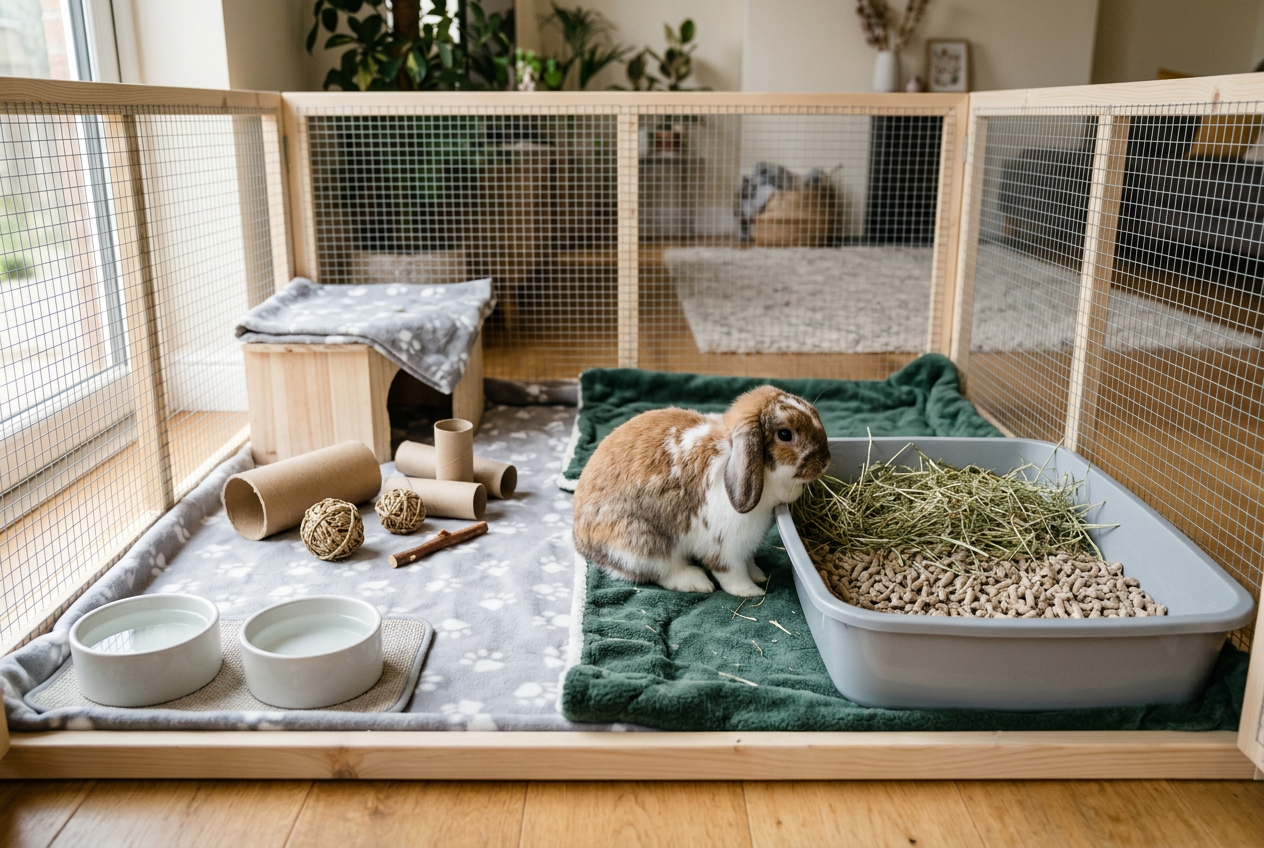
The Rabbit Welfare Association and Fund (RWAF) outlines a clear baseline: a bonded pair of average-sized rabbits requires a continuous, accessible living area of at least 3 metres by 2 metres, by 1 metre high (10ft x 6.6ft x 3.3ft). This represents a total footprint of 6 square metres of unbroken space. While some owners dedicate an entire rabbit-safe room or allow total free-roaming access, a modular puppy exercise pen attached to a base area is the most practical solution for most British homes.
- Free-roaming: The rabbit has full, supervised or unsupervised run of the entire home or specific rooms, much like an indoor cat.
- Dedicated rabbit room: A spare bedroom or study proofed entirely for the rabbits, giving them constant freedom within a safe boundary.
- Exercise pen (x-pen) base: A modular puppy pen enclosure providing the minimum 6 square metres, used when unsupervised, paired with daily free-run time in the wider home.
Flooring and Foot Health
Unlike dogs and cats, rabbits do not have protective footpads. Their hocks are covered only by a layer of coarse fur resting over skin and bone. Hard, slick surfaces like laminate flooring, hardwood, tiles, or linoleum offer zero traction. Rabbits forced to navigate slippery floors often develop arthritis, hip strain, or painful pododermatitis (ulcerative sore hocks).
Cover all living areas with short-pile, low-loop rugs, cotton runners, or dense foam play mats topped with washable fleece. Avoid high-pile looped carpets, as rabbit claws can catch in the loops, causing severe toe dislocations or nail avulsions.
How Do You Rabbit-Proof an Indoor Living Space?
Rabbits possess an innate, instinctual urge to chew and dig. In the wild, their teeth grow continuously throughout life, and chewing tough roots maintains dental wear while digging excavates warrens. Indoors, this biological drive turns toward electrical cables, wooden skirting boards, wallpaper, and sofa linings. Protecting your home and your pet requires methodical rabbit-proofing before granting floor access.
- 1
Encase all electrical wires
Electrical flexes are the primary hazard indoors. A single bite through an active cable can cause severe oral electrical burns or fatal cardiac arrest. Encase every exposed wire in heavy-duty, split-tubing cable protectors or run them behind solid plastic trunking fixed firmly to walls.
- 2
Protect skirting boards and corners
Baseboards sit directly at eye level for a rabbit. Fit clear plastic corner guards or position solid wooden blocking along vulnerable walls. Providing safe untreated apple or willow wood branches gives your rabbit an appropriate chewing alternative.
- 3
Remove toxic houseplants
Many popular indoor plants are deadly to lagomorphs. Lilies, philodendron, monstera, pothos, dieffenbachia, and ivy must be removed entirely from rooms where rabbits exercise, as falling dried leaves present an ingestion risk.
- 4
Block access behind and beneath furniture
Rabbits can squeeze into surprisingly narrow gaps behind radiators, sofas, and television stands. Use grid storage cubes (C&C grids) or wooden barriers to prevent them from becoming trapped or chewing fabric bases.
What Should You Feed an Indoor House Rabbit?
The digestive system of a rabbit is designed for extracting nutrients from poor-quality, fibrous vegetation. Feeding an improper diet is the leading cause of preventable illness and premature death in domestic rabbits. A balanced daily intake ensures continuous gut movement and wears down open-rooted teeth to prevent catastrophic rabbit dental disease.
Ideal Daily Diet Composition for House Rabbits
Feeding Hay: The Non-Negotiable Foundation
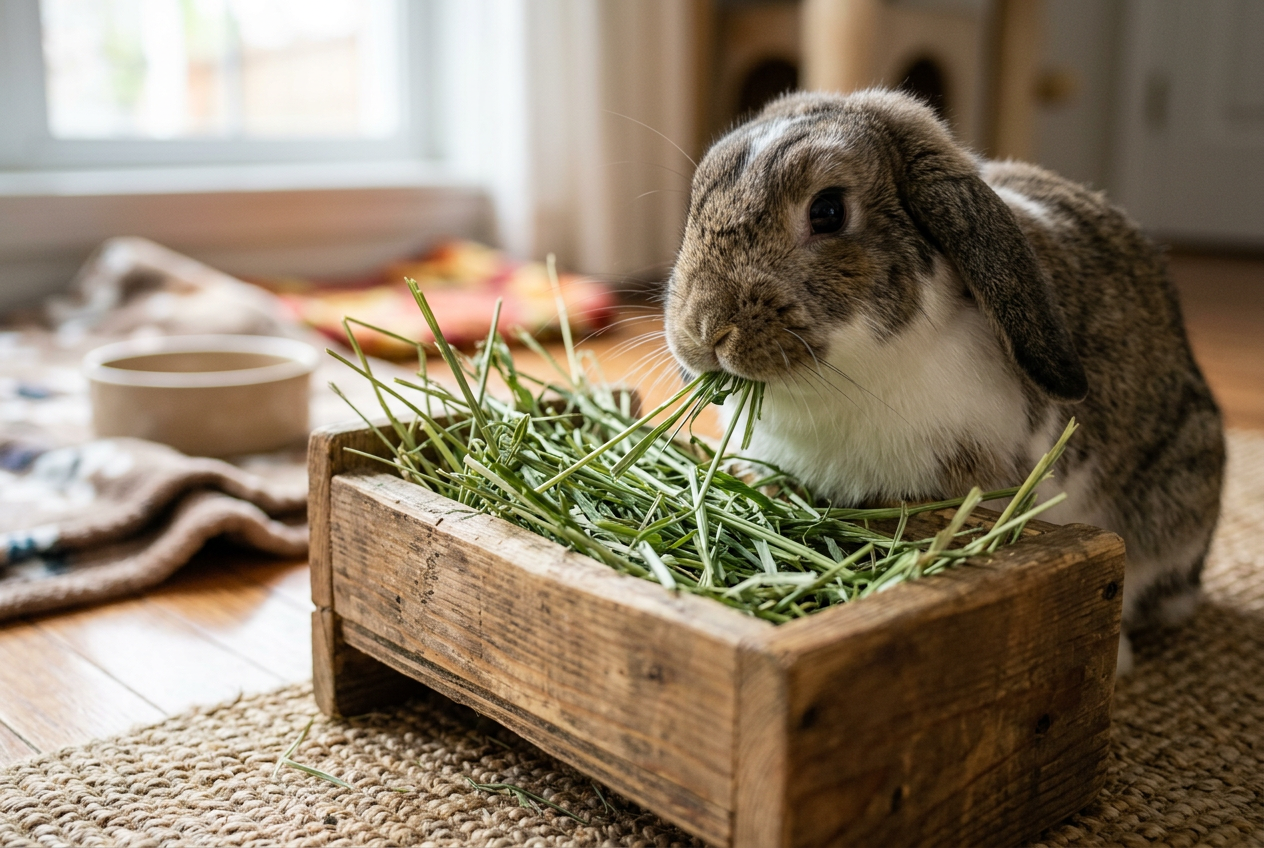
Feeding hay or fresh, clean, un-mown grass must make up at least 85% to 90% of your rabbit's total diet by volume. An adult rabbit should consume a bundle of feeding hay equal to their own body size every single day. High-fibre long-stem grasses like Timothy, meadow, orchard grass, and rye keep the caecum functioning smoothly and grind down premolars and incisors.
Avoid feeding legume hays such as alfalfa (lucerne) to healthy adult rabbits. Alfalfa contains high levels of protein and calcium, which can lead to rapid weight gain and urinary sludge or bladder stones. Reserve alfalfa strictly for growing kits under six months old or nursing does.
Leafy Greens and Commercial Pellets
Alongside unrestricted hay, adult house rabbits benefit from an adult-sized handful of fresh, rabbit-safe leafy greens daily. Excellent choices include coriander, flat-leaf parsley, mint, basil, romaine lettuce, dill, and celery tops. Avoid iceberg lettuce, as it contains lactucarium which causes watery diarrhoea, and limit high-oxalate greens like spinach to occasional treats.
Pellets should be viewed strictly as a mineral supplement, not a meal. Offer only uniform, plain, extruded timothy-based kibble—specifically measuring approximately one level tablespoon per kilogram of ideal body weight daily. Never feed muesli-style seed and grain mixes. Muesli encourages selective feeding, picking out sugary flakes while leaving vital minerals, directly causing severe dental malocclusion and obesity. Learn more about choosing suitable rabbit pellets.
How Do You Litter Train a House Rabbit?
One of the greatest benefits of keeping rabbits indoors is that they can be easily litter trained. Wild rabbits naturally designate specific latrine sites along territorial borders. In a domestic setting, you can harness this instinct by positioning a large, open litter tray where they naturally prefer to toilet.
Rabbits love to graze on hay while they defecate and urinate. Setting up a hay rack or a pile of fresh hay directly above or inside one half of the litter tray is the single most effective way to establish reliable litter habits quickly.
| Litter Type | Absorbency | Odour Control | Safety Profile |
|---|---|---|---|
| Recycled Paper Pellets | High | Excellent | Very Safe; digestible if tiny amounts ingested accidentally |
| Kiln-Dried Wood Pellets | Very High | Superior | Safe; aromatic phenols removed during kiln process |
| Clean Barley or Oat Straw | Low | Poor | Safe; best used as a soft top layer rather than an absorbent base |
| Clumping Clay Cat Litter | High | Moderate | Dangerous; causes fatal internal gut impaction if ingested |
| Softwood Wood Shavings | Moderate | Moderate | Unsafe; un-kilned pine or cedar releases harmful respiratory phenols |
Use a generous layer of recycled paper pellets covered by a deep bed of clean feeding hay. Clean the tray completely every two to three days using a diluted white vinegar solution to dissolve stubborn calcium urine deposits naturally without harsh fumes.
Why Do House Rabbits Need Companionship?
Domestic rabbits descend directly from European wild rabbits (*Oryctolagus cuniculus*), a colonial prey species whose survival depends on close social grouping. Human companionship, while meaningful, can never replace the 24-hour mutual grooming, communication, and comfort of another rabbit.
Single house rabbits often exhibit chronic stress, depression, over-grooming, and destructive behaviour. Welfare organisations like the RSPCA and RWAF strongly advocate keeping rabbits in compatible, neutered pairs. Most UK rescue centres will only rehome them in existing bonded pairs or help you introduce a partner through adopting rabbits in pairs.
The most reliable partnership is an adult neutered male paired with an adult neutered female. Two unneutered males or unneutered females will inevitably fight aggressively once sexual maturity arrives between 4 and 6 months of age. Introducing unfamiliar rabbits requires a careful, neutral-territory protocol outlined in our guide on bonding rabbits safely.
Daily Care Routines and Understanding Handling
Establishing a consistent daily care routine helps you spot subtle signs of illness early. A healthy house rabbit is curious, responsive, and eagerly anticipates meals. Every morning and evening, assess your rabbit's energy levels, verify their water intake, check that their litter tray contains a normal quantity of round, dry droppings, and replenish fresh hay.
Why Rabbits Dislike Being Picked Up
The most common misunderstanding between humans and house rabbits revolves around handling. As ground-dwelling prey animals, being lifted into the air simulates being snatched by a bird of prey or a fox. It triggers an intense, instinctual panic response. Many rabbits kick out violently when scooped up, risking severe fractures to their fragile lumbar spine.
Instead of picking up your rabbit for affection, sit or lie calmly down on the floor at their level. Let them approach you on their own terms. When they realise you will not hoist them into the air, they will readily climb into your lap, nudge your fingers for head rubs, and sprawl beside you in deep contentment.
Essential Veterinary Care and Preventive Health
Even completely indoor house rabbits require dedicated veterinary oversight and routine vaccinations. Infectious viral particles can easily be carried indoors on owners' shoes, clothes, fresh foraging greens, or by biting insects like mosquitoes and fleas that enter the home.
- Annual UK Vaccinations: Protects against Myxomatosis, Rabbit Haemorrhagic Disease Virus 1 (RHD1), and Rabbit Haemorrhagic Disease Virus 2 (RHD2). Modern single-injection triple vaccines make full annual protection straightforward.
- Neutering (Castration/Spay): Essential from 4 to 6 months of age. Beyond eliminating hormonal spraying and aggression, uterine adenocarcinoma affects up to 70–80% of unspayed female rabbits over four years of age. Spaying is life-saving preventive healthcare.
- Routine Dental Checks: A rabbit-savvy vet should inspect the back molar spurs with an otoscope during every annual checkup.
- Nail Trimming: Indoor rabbits do not wear their nails down on concrete or burrows. Trim their claws every 6 to 8 weeks to avoid torn digits.
Indoor Enrichment: Keeping an Active Mind
Boredom is a significant risk factor for behavioural problems and physical decline in indoor rabbits. In the wild, rabbits spend hours foraging, investigating scent trails, and altering their burrow networks. Indoor rabbits require deliberate environmental enrichment to fulfil these drives.
Create simple, inexpensive foraging puzzles using cardboard toilet roll tubes stuffed with meadow hay and dried herbs. Provide large cardboard boxes with multiple entrance and exit holes cut out to serve as multi-level tunnels. A shallow plastic storage container filled with child-safe play sand, shredded untreated paper, or organic soil makes an outstanding indoor digging box that redirects digging behaviour away from your carpets.
Frequently asked questions
Can house rabbits be left alone during the working day?
Yes, provided they live in a spacious, fully rabbit-proofed pen with a compatible, bonded rabbit companion. Because rabbits are crepuscular—most active at dawn and dusk—they typically spend the middle of the day resting and napping quietly. Always leave abundant fresh hay and multiple water bowls.
Do indoor house rabbits smell bad?
Rabbits themselves are clean animals that groom constantly and have virtually no body odour. Any unpleasant smell in a home stems from a neglected litter tray. Using absorbent recycled paper pellets, changing the tray every two to three days, and neutering your rabbit to stop hormonal urine spraying eliminates scent issues.
Do house rabbits really need vaccinations if they never go outside?
Yes, indoor rabbits absolutely require vaccination against Myxomatosis, RHD1, and RHD2. These deadly viruses can easily be brought into your home on shoes, outdoor clothing, gathered forage, or through insects like mosquitoes and flies that enter open windows during summer months.
Should I provide a water bottle or a ceramic water bowl?
Ceramic water bowls are far superior to drip bottles. Studies show rabbits drink significantly more water from an open dish, which promotes kidney health and reduces bladder sludge risk. Bowls support a natural, comfortable drinking posture. Choose a heavy ceramic bowl that cannot be flipped over easily.
At what age should a house rabbit be neutered?
Bucks (males) can generally be castrated as soon as their testicles descend, typically between 10 and 16 weeks of age. Does (females) are usually spayed between 4 and 6 months once they reach reproductive maturity. Always consult an experienced, rabbit-savvy vet to determine individual surgical readiness.
Can house rabbits live safely with indoor cats or dogs?
Rabbits can coexist in homes with cats and calm dogs, but they must never be left unsupervised together. Dogs and cats have strong predatory drives that can be triggered in an instant. Ensure the rabbits have their own private, secure enclosure where other household pets have zero physical access.
What is the best room temperature for an indoor house rabbit?
The ideal ambient temperature for house rabbits is between 15°C and 20°C (59°F to 68°F). Rabbits tolerate cool conditions far better than heat. Temperatures exceeding 25°C (77°F) put them at serious risk of heatstroke, so keep their enclosure away from radiators, sunny unshaded windows, and draughts.
Sources and further reading
- Indoor Housing Recommendations — rabbitwelfare.co.uk
- Rabbit Diet and Nutrition Guidelines — rabbitwelfare.co.uk
- How to Care for House Rabbits — rspca.org.uk
- pdsa.org.uk — guidance library — pdsa.org.uk
- Indoor Rabbit Care and Behaviour — bluecross.org.uk
More from Petarium Daily
- Cat Body Language: How to Read Your Cat's Subtle Signals
Cat body language is a sophisticated visual communication system relying on subtle shifts in the ears, eyes, tail, whiskers, and overall posture. Because cats are both solitary hunters and prey animals, recognising these understated signals is essential for preventing fear, reducing stress, and building trust.
- How to Toilet Train a Puppy: A Kind, Practical Guide
To toilet train a puppy, take them to a suitable toilet spot frequently, reward them immediately after they finish and prevent accidents through close supervision. Expect gradual progress over weeks to months, with night-time breaks and adjustments for your puppy’s age, health and individual needs.
- How to Crate Train a Puppy: A Kind, Step-by-Step Guide
Teach your puppy to enjoy a crate by rewarding voluntary entry, introducing the closed door for seconds and gradually building comfortable resting time. Stay nearby at first, provide frequent toilet breaks and reduce the difficulty whenever your puppy shows distress.