
Exotic pets
Enrichment for Bearded Dragons
Simple ways to give a bearded dragon more choice, exercise and natural behaviour.
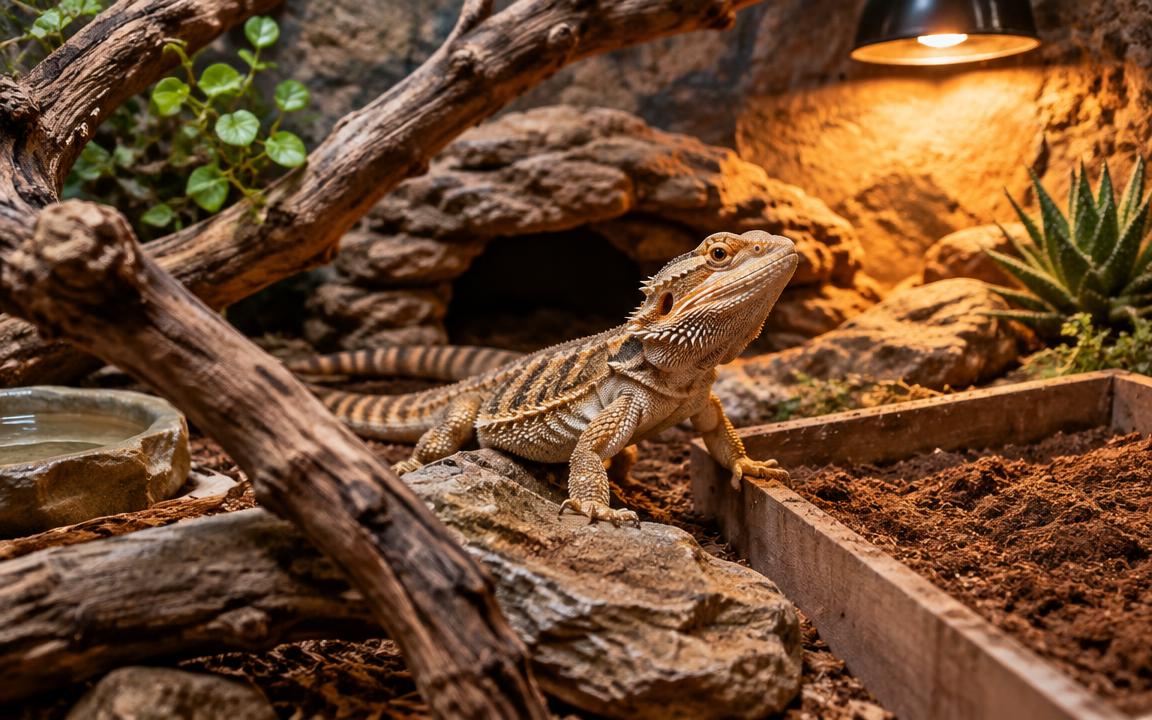
AI-generated editorial image; illustrative, not a clinical demonstration or documentary photograph.
Enrichment that matches natural behaviour
| Behaviour | How to offer it |
|---|---|
| Thermoregulating | A real gradient: basking platform, warm middle, shaded cool end. |
| Climbing and surveying | Sturdy branches and stacked levels; at least one hide per end. |
| Digging | A deep dig box or digging corner of safe substrate. |
| Hunting and foraging | Prey released to hunt; plant foods scattered or hidden. |
| Exploring | Supervised time in a secure, warm, dragon-proofed space. |
Persistent hiding, glass-surfing or food refusal is a husbandry or health signal, not laziness — check temperatures and UVB, then a reptile vet.
What enrichment means for a reptile
Enrichment for bearded dragons is not about toys. It means giving the animal opportunities to perform the behaviours it is built for: basking and thermoregulating across a gradient, climbing, digging, foraging for food, and surveying its surroundings from height. A dragon that can do these things is measurably more active and shows fewer of the repetitive, lethargic patterns common in bare enclosures.
The starting point is the enclosure itself. A dragon in a vivarium too small to offer a real temperature gradient and usable floor space cannot be enriched by gadgets. Get the size, heat and UVB right first — enrichment builds on correct husbandry, it does not substitute for it.
Structuring the enclosure
Think in three dimensions. Provide a basking platform under the heat source, stacked levels or sturdy branches for climbing, a shaded cool end, and at least one snug hide — ideally two, one at each temperature end, so the animal never has to choose between security and the right temperature.
Digging is one of the most under-used natural behaviours. A deep dig box of safe substrate, or a designated digging corner, gives females somewhere appropriate to dig (important even without a male present, as they can produce infertile eggs) and gives every dragon an outlet for a strong instinct. Rearrange furnishings occasionally; modest novelty in layout prompts exploration without the stress of a full environment change.
Food as enrichment
Feeding is the easiest place to add behavioural variety. Instead of presenting insects in a bowl every day, release some for the dragon to hunt, use feeding tongs to make it work for moving prey, and hide chopped greens or vegetables among furnishings or in a foraging toy so the animal searches for them.
Vary feeding locations rather than always using the same spot
Offer live prey to hunt a few times a week where safe and supervised
Scatter or hide plant foods to encourage foraging
Use appropriately sized prey — no wider than the space between the dragon's eyes
Keep a predictable feeding rhythm overall; variety in presentation, not chaos in schedule
Safe out-of-enclosure time
Supervised exploration outside the vivarium adds real variety: a secure, warm, dragon-proofed room or a purpose-built pen where the animal can walk, climb on low stable objects and investigate. Keep sessions away from other pets, especially dogs and cats, whose presence is stressful even without contact, and never leave the animal unattended.
Some dragons tolerate harness walks outdoors in warm weather, but many find them stressful; read the individual animal and prioritise temperature — a chilled dragon is a stressed dragon. Handling itself is neutral-to-positive for habituated animals when kept short, supported and calm, but it is interaction, not exercise.
Reading whether it is working
An enriched dragon is alert, uses different parts of the enclosure through the day, moves between basking and cool zones, and investigates new items. Warning signs that something is wrong rather than merely quiet include persistent hiding, glass-surfing for long periods, refusing food, or lethargy outside normal brumation timing — those warrant a husbandry review and, if they persist, a reptile-experienced vet.
Introduce changes one at a time and watch the response. Enrichment that frightens the animal — a new object it flees from repeatedly, a feeding method it never engages with — is not enrichment for that individual. The aim is a dragon that chooses to be active, and choice is the measure.
Frequently asked questions
- Do bearded dragons get bored?
- They show reduced activity and repetitive behaviour in barren environments and increased exploration when given complexity, which welfare researchers read as meaningful. Whether to call that 'boredom' is debated, but providing behavioural opportunities is clearly beneficial.
- Can two bearded dragons keep each other company?
- No — cohabiting is a welfare risk, not enrichment. Bearded dragons are solitary, and pairs frequently result in aggression, stress and injury. House them separately.
- Is it safe to let my dragon roam the house?
- Unsupervised roaming is risky: cold floors, escape gaps, other pets, and ingestible hazards. Use supervised sessions in a secure, warm, proofed area instead.
- My dragon just sits in one spot. Is that normal?
- Some stillness is normal, especially after meals and in cooler seasons. But a dragon that never moves between zones, eats poorly or glass-surfs persistently needs a husbandry check — temperatures, UVB and enclosure layout — before assuming it is simply lazy.
References
- Bearded dragon care and environment — RSPCA
- Bearded dragons: husbandry and care — VCA Animal Hospitals