Petarium Daily · 30 September 2026 · 11 min read
Yavru köpek maması: A Complete Guide to Puppy Food
Yavru köpek maması means puppy food: choose a complete diet formulated for growth and suitable for your puppy’s expected adult size. Feed measured meals, adjust portions using weight and body condition, and change foods gradually rather than relying on a universal grams-per-day rule.

Key takeaways
- Choose food labelled complete for puppies or growth, not complementary food.
- Large and giant breeds need diets suitable for their growth requirements.
- Use the feeding guide as a starting point, then adjust with your veterinary team.
- Most puppies move from four daily meals to three, then two as they grow.
- Keep treats within 10% of daily calories and avoid unnecessary supplements.
- Repeated vomiting, bloody diarrhoea, marked weakness or a swollen abdomen require urgent veterinary advice.
Yavru köpek maması means “puppy food” in Turkish. The right choice is a complete food formulated for puppies or growth, suitable for your puppy’s expected adult size. Feed measured portions across several meals, provide fresh water and adjust the amount as your puppy grows. There is no single best ingredient list or daily gram allowance for every puppy: nutritional balance, calorie content and healthy growth matter most.
What should you look for on a puppy food label?
Start with the nutritional purpose, not the packaging. In the UK, complete means the food is intended to provide all necessary nutrients when fed as directed for the stated life stage. Complementary food cannot provide a balanced diet on its own, even when it looks like a substantial meal.
- Look for a complete food intended for puppies or growth, rather than adult maintenance alone.
- Check whether it suits your puppy’s expected adult size, particularly for large and giant breeds.
- Find a feeding guide based on age and weight; check whether it uses current weight or expected adult weight.
- Look for calorie information, ideally kilocalories per kilogram, per 100 g or per container.
- Choose a manufacturer that can explain its nutritional expertise, quality controls and how the diet’s suitability for growth is established.
Terms such as “premium”, “natural” and “high meat” do not establish nutritional adequacy. An attractive ingredients list cannot show whether calcium, phosphorus and other nutrients are correctly balanced. Our guide to choosing a safe natural diet for dogs explains why appealing descriptions should not replace a proper nutritional assessment.
Is wet or dry puppy food better?
| Format | Practical advantages | What to check |
|---|---|---|
| Dry food | Easy to weigh, store and use as training rewards. | Energy density varies; a small extra handful can add substantial calories. |
| Wet food | Provides more moisture and may appeal to puppies that prefer softer textures. | Usually requires more grams for the same calories; refrigerate opened food as directed. |
| Mixed feeding | Offers both textures and can suit household routines. | Divide one daily calorie allowance between the foods rather than feeding a full allowance of each. |
Neither format is automatically healthier. Compare the amount needed to supply the same calories, not simply the price per bag or the protein percentage on the label: wet food’s moisture changes those percentages. Ordinary dry kibble is also not a substitute for toothbrushing and appropriate dental care.
Why does your puppy’s expected adult size matter?
Large and giant breeds need carefully controlled energy and mineral intake during growth. Excess calories encourage unnecessarily rapid growth, while inappropriate calcium intake can affect skeletal development. Choose a complete puppy diet specifically suitable for large-breed growth; trying to make a puppy grow as quickly as possible is not a healthy goal.
Small and toy breeds also need balanced nutrition, but smaller mouths and greater vulnerability to missed meals can influence feeding arrangements. A suitable kibble size may help, and very young toy puppies may need more frequent meals. For a crossbreed with uncertain adult size, ask your vet to help estimate growth needs using age, current size and parental information.

How much puppy food should you feed each day?
Use the pack’s feeding guide as a starting point, not a fixed prescription. Puppies of the same weight can need different amounts because of age, activity, body condition and expected adult size. Food energy density varies too, so copying another owner’s scoop size can produce significant overfeeding or underfeeding.
- 1
Check the correct feeding-guide column
Weigh your puppy and confirm whether the guide refers to current weight or expected adult weight. Puppy charts often combine age with anticipated adult size.
- 2
Measure the whole day’s allowance
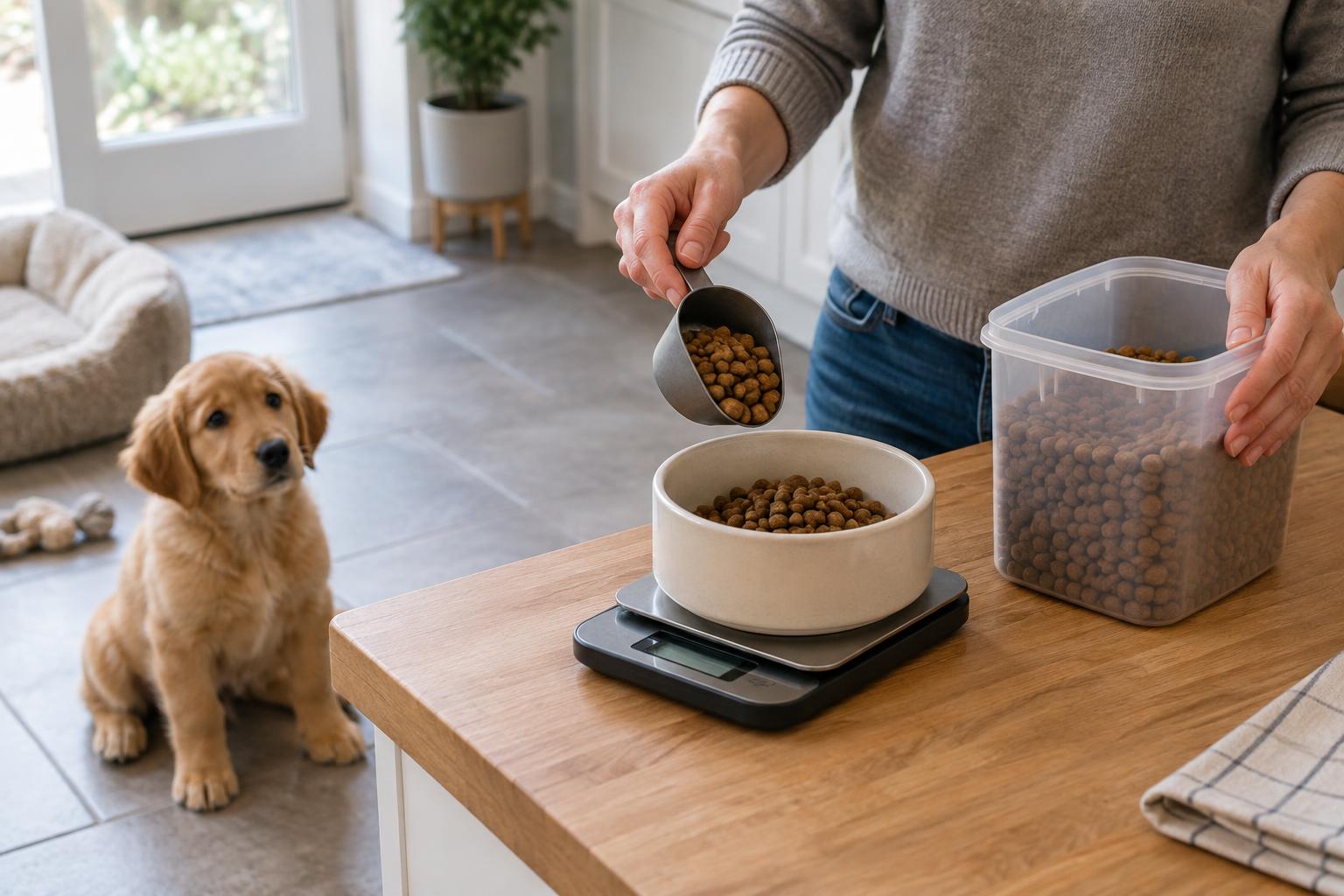
Use kitchen scales for dry food. For wet food, use the stated container weight and feeding instructions rather than judging the amount by bowl size.
- 3
Include every source of calories
Account for treats, chews, toppers and food-filled toys. Keep part of the measured daily food aside for training so rewards do not become an uncounted extra meal.
- 4
Divide the allowance into meals
Share the daily amount across the appropriate number of meals. Do not mistake a daily feeding recommendation for the amount to serve at each sitting.
- 5
Review growth and body condition regularly
Record weight every one to two weeks during rapid growth where practical. Review the trend with your veterinary team and make measured adjustments rather than reacting to one unusually hungry day.
For example, if an appropriate daily food allowance has already been established as 600 kcal, a food containing 400 kcal per 100 g would supply that in 150 g. A food containing 300 kcal per 100 g would require 200 g. These figures illustrate the calculation only; 600 kcal is not a recommendation for your puppy.
How many meals should a puppy have?
Typical puppy meal frequency by age
Smaller, regular meals make it easier for a puppy to eat enough without a very large meal overwhelming a small stomach. When reducing meal frequency, redistribute the daily allowance rather than simply removing a meal’s worth of food. Two meals daily remain a practical routine for many adult dogs.
Feed in a quiet space and separate pets so that you can see who eats what. Predictable meals also help you anticipate toilet breaks; our practical dog-training guide explains how consistent, reward-based routines support learning. Fresh water should remain available, including overnight, unless your vet gives specific medical instructions.
How should you change a puppy’s food?
- 1
Begin with the familiar diet
Ask the breeder, rescue or previous carer for the exact food and feeding routine. Avoid an unnecessary immediate change while your puppy is also settling into a new home.
- 2
Introduce a small proportion of the new food
A common starting point is roughly 75% old food and 25% new food for the first couple of days, adjusted for differences in calorie density.
- 3
Increase gradually if stools remain normal
Move through approximately equal portions, then mostly new food, over about seven to ten days. Sensitive puppies may need a slower transition.
- 4
Monitor rather than pushing through illness
Watch appetite, stools and energy. Seek veterinary advice if diarrhoea develops, particularly in a very young puppy or when other symptoms occur.
A transition schedule is a practical guide, not a requirement to continue regardless of symptoms. Sudden diet changes can upset digestion, but infections, parasites and swallowed objects can cause similar signs. Do not assume that vomiting or diarrhoea is merely the new food, and do not repeatedly switch diets without advice.
What if the puppy is still being weaned?
Weaning usually begins at around three to four weeks and is generally complete by seven to eight weeks. Puppies need age-appropriate food and careful monitoring during this period. An orphaned, underweight or not-yet-weaned puppy needs prompt veterinary guidance; cow’s milk and ordinary puppy meals are not substitutes for an appropriate milk-feeding plan.
Can puppies have treats, toppers and supplements?
Keep treats and other nutritionally incomplete extras to no more than 10% of daily calories, leaving at least 90% for the complete diet. Tiny rewards are sufficient for learning; measured pieces of your puppy’s regular food work well too. Follow the reward-based training advice without letting frequent practice turn into substantial extra feeding.
Do not routinely add calcium, vitamins or mineral powders to a complete puppy food. More is not necessarily better, and excesses can disrupt a carefully balanced diet. Toppers such as meat, eggs or yoghurt also add calories and dilute nutritional balance when they replace too much complete food; discuss any intended supplement with your vet.
- Never offer chocolate, grapes, raisins, onions, garlic, alcohol or foods containing xylitol.
- Avoid cooked bones and hard objects that may splinter, obstruct the gut or damage teeth.
- Keep fatty leftovers and heavily salted or seasoned foods out of the feeding routine.
- Supervise chewing and choose items suitable for the puppy’s size and developmental stage.
How can you tell whether a puppy food is suitable?
Look for steady growth, a lean body condition, normal activity and consistently formed stools, rather than dramatic changes promised by marketing. Persistent itching, ear problems or loose stools need assessment rather than an assumption of food allergy. Before replacing a complete food with home-prepared meals, read our guide to nutritional safety in natural dog diets and seek qualified veterinary nutrition advice.
A missed meal deserves closer attention in a young puppy than in a healthy adult dog, especially in toy breeds. Contact your vet promptly if a young puppy refuses food, and urgently if they are also weak, shaky or unusually sleepy. Do not withhold food for a prolonged period or force-feed a vomiting or distressed puppy.
When should you switch from puppy food to adult food?
| Expected adult size | Common transition window | Main consideration |
|---|---|---|
| Small breeds | Around 9–12 months | Confirm that the puppy is approaching adult size. |
| Medium breeds | Around 12 months | Review growth, activity and body condition. |
| Large breeds | Around 12–18 months | Continue an appropriate growth diet until sufficiently mature. |
| Giant breeds | Around 18–24 months | Their longer growth period needs individual assessment. |
Switch because growth requirements have changed, not simply because the puppy has been neutered or appears hungry. Energy needs may change after neutering, so portions can need reassessment while growth nutrition remains important. Transition gradually, and seek advice if excess weight develops rather than using adult food as an improvised weight-loss diet.
How should you store and serve puppy food safely?
- Keep dry food cool and dry, preferably in its original bag inside a clean, secure container. Retain the batch details and best-before date.
- Seal and refrigerate opened wet food promptly, following the label’s storage and use-by instructions.
- Remove uneaten wet food promptly, especially in warm conditions; do not leave it available all day.
- Wash bowls and utensils regularly, and wash your hands after handling food.
- Discard mouldy, rancid or pest-contaminated food. Store food where puppies cannot raid the supply.
What should your everyday puppy-feeding checklist include?
Keep the essentials simple: an appropriate complete growth diet, measured portions, regular meals, fresh water and a record of weight changes. If you prefer home-prepared feeding, the safe-diet principles in our natural feeding guide are a starting point, not a puppy recipe. A growth diet needs formulation by a veterinary nutrition specialist, not guesswork with meat, vegetables and supplements.
Frequently asked questions
What does yavru köpek maması mean?
Yavru köpek maması is Turkish for puppy food. When choosing it, look for a complete diet formulated for growth and suitable for your puppy’s expected adult size. The wording on an online listing is not enough: check the nutritional description, feeding guide and suitability stated on the actual packaging.
Can a puppy eat adult dog food?
An occasional accidental mouthful is unlikely to cause a nutritional problem, but adult maintenance food should not be a puppy’s regular diet. Growth requires a different nutritional balance. A food intended for all life stages may be suitable only if its stated suitability includes your puppy’s growth needs, particularly for large breeds.
How many grams should an eight-week-old puppy eat?
There is no safe universal gram allowance for an eight-week-old puppy. The amount depends on current weight, expected adult size and the food’s calorie content. Start with that food’s puppy feeding guide, check the interpretation with your vet and usually divide the daily allowance into four small meals.
Should I soak dry puppy food?
You can soften suitable puppy kibble with warm water if your puppy prefers it or is moving on from softened weaning food. Let it cool before serving, prepare small portions and discard leftovers promptly. Persistent difficulty chewing, dropping food or apparent mouth pain needs a veterinary check rather than simply softer meals.
Is grain-free puppy food healthier?
Grain-free food has no established general health advantage for puppies. Nutritional balance matters more than the absence of grains. Some diets, including certain grain-free formulations, have been investigated in relation to canine dilated cardiomyopathy; the relationship is complex and still being studied. Discuss diet selection with your vet rather than choosing by a grain-free claim.
Why does my puppy seem hungry after every meal?
Some puppies are highly food-motivated even when their nutritional needs are met. Check the feeding guide, calorie content, weight trend and body condition before increasing portions. More frequent division of the same allowance may help. Persistent hunger accompanied by weight loss, poor growth, diarrhoea or other changes warrants veterinary assessment.
Can I feed my puppy homemade chicken and rice?
Chicken and rice alone is not a complete growth diet and can cause nutritional deficiencies if fed regularly. It should not replace balanced puppy food as a routine response to digestive problems. A puppy with vomiting or diarrhoea needs veterinary advice, while long-term homemade feeding requires a properly formulated recipe from a veterinary nutrition specialist.
Sources and further reading
- Global Nutrition Guidelines — World Small Animal Veterinary Association
- Feeding Growing Puppies — VCA Animal Hospitals
- PDSA — guidance library — PDSA
- Obesity in dogs — PDSA
- People Foods to Avoid Feeding Your Pets — ASPCA
More from Petarium Daily
- How Long Do Rabbits Live? Lifespan and Healthy Ageing
Pet rabbits usually live for around 8–12 years, although some reach their teens and others die younger. Genetics play a part, but appropriate feeding, spacious housing, rabbit companionship, vaccination and prompt veterinary care all help support a longer, healthier life.
- Dog Training Tips: A Practical Guide to Better Behaviour
The most effective dog training tips are to reward behaviours you want, practise in manageable steps and prevent unwanted habits without frightening or hurting your dog. Short, enjoyable sessions, consistent cues and realistic expectations help puppies and adult dogs learn.