
Handling
Carrier Training for Cats: Making Vet Trips Easier
Teach your cat to walk into the carrier calmly with a slow, reward-based plan.
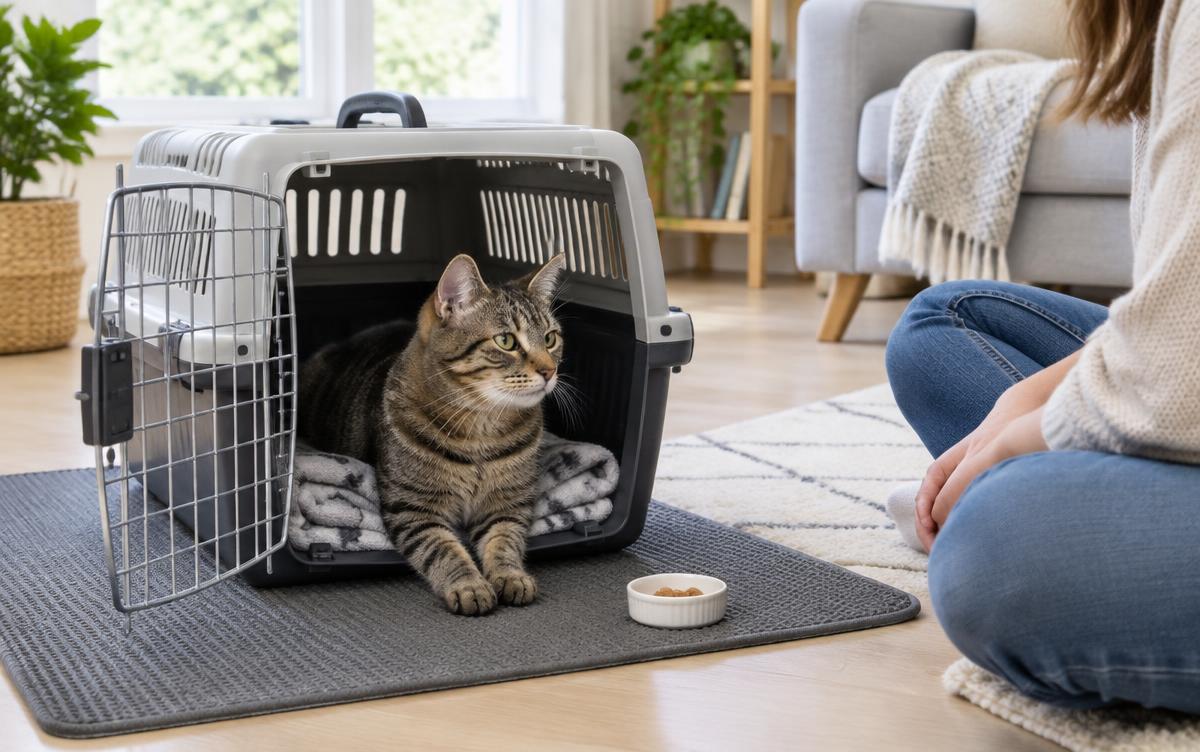
AI-generated editorial image; illustrative, not a clinical demonstration or documentary photograph.
Carrier confidence: one change at a time
| Stage | Ready to progress when… |
|---|---|
| Familiar place | Your cat approaches the stable, open carrier without pressure. |
| Voluntary entry | Your cat enters comfortably and can leave again. |
| Door movement | Brief movement or closure does not cause distress. |
| Lift and carry | Your cat remains comfortable while the base is supported and level. |
| Travel preparation | The carrier is secured using the manufacturer's instructions. |
There is no fixed timetable. Return to an easier stage if distress increases; urgent veterinary care must not wait for training.
Make the carrier part of ordinary home life
A carrier that appears only before a stressful trip can become a warning signal. Leave a secure carrier in a quiet room with familiar bedding and the door held safely open. It should allow your cat to stand, turn and lie comfortably without unstable parts or sharp edges. A removable top can make veterinary examinations easier, but reliable catches and secure closure matter more than appearance.
Choose a location away from noisy appliances and busy routes. Do not block the cat's access to food, litter or resting places. Let it investigate without being lifted into the opening. Cats differ in confidence; progress should be based on relaxed behaviour rather than a deadline or a fixed number of days.
Build voluntary entry in small steps
Start by rewarding an approach to the carrier. Place a suitable reward near the entrance, then gradually farther inside as the cat becomes comfortable. Familiar bedding or a favourite toy may help. If the cat stretches forward but keeps its hind feet outside, that is information: the step may be too large. Move the reward closer and make the task easier.
Do not use hunger to force entry or shut the door immediately after a hesitant first visit. That can make entering feel like a trap. Reward small successes and allow the cat to leave. If you use a marker word, keep it quiet and consistent. End before the cat becomes tense or stops taking an otherwise valued reward.
Teach door closure separately from travel
Once the cat rests or eats comfortably inside, briefly move the door without closing it. Next practise a moment of closure, reopen it and reward calm behaviour. Increase only when the cat remains comfortable. Pawing, crouching, persistent vocalisation or refusal to re-enter suggests you should return to an easier stage.
Lifting the carrier, carrying it through the house and approaching a stationary vehicle are separate tasks. Keep the carrier level and support its base. Avoid swinging it by the handle or balancing it where it could fall. A towel cover may reduce visual stimulation, but maintain ventilation and check that the cat does not overheat.
Prepare the journey safely
Follow the vehicle and carrier manufacturer's restraint instructions so the carrier cannot slide or become a projectile. Never let a cat roam freely in a moving vehicle. Keep temperatures comfortable, avoid direct sun and do not leave the animal in a parked car. Check doors and catches before moving between the house and vehicle.
For a long trip, discuss feeding, water, toileting and medical needs with the veterinarian in advance. Never open the carrier beside an unprotected road or in a car park. Ask the clinic whether you can wait in the vehicle or a quieter area, provided temperatures and supervision remain safe.
When there is no time for training
Urgent care must not wait for a cat to complete a training plan. Call the clinic for advice about safe loading and handling. A removable-top carrier may allow gentle placement without pushing the cat through a narrow door. Avoid a prolonged chase, gripping limbs or compressing the chest. Painful or breathless cats need particular care and immediate professional direction.
For repeated travel distress, ask about an individual low-stress plan. A vet may consider prescribed medicine after assessing the cat, but do not give human sedatives, another pet's prescription or over-the-counter remedies without advice. Training can improve future journeys without guaranteeing that every trip will be stress-free.
Frequently asked questions
- How long should carrier training take?
- There is no fixed timetable. Advance when your cat remains comfortable, and return to easier steps if distress increases.
- Should I leave the carrier out permanently?
- It can help the carrier become familiar if it is stable, comfortable and does not obstruct essential resources.
- Can I skip training during an emergency?
- Yes. Seek care immediately and ask the clinic for safe handling advice; do not delay urgent treatment.
- Can a calming product replace training?
- Not reliably. Discuss severe distress with your vet; products do not replace safe transport, gentle handling and gradual learning.
References
- Cat welfare and care guidance — International Cat Care
- Travelling with your cat — Cats Protection