
Home care
How to Give Your Cat a Tablet
Calm, step-by-step ways to give cats tablets, plus alternatives if your cat refuses.
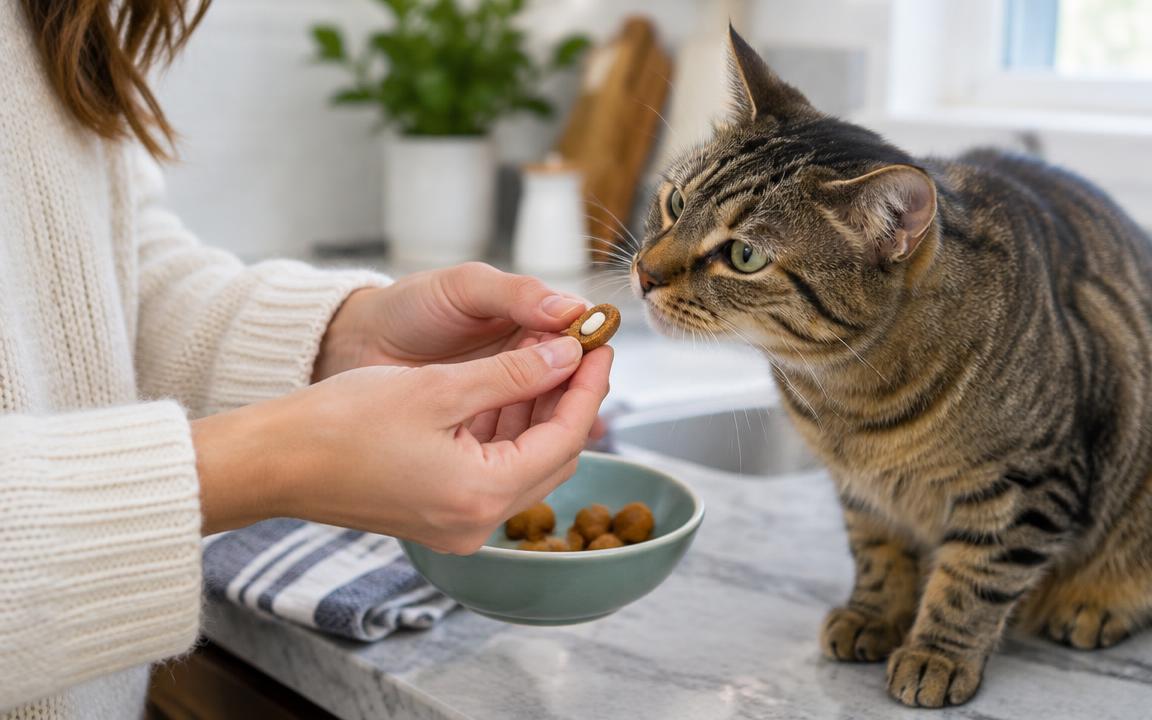
AI-generated editorial image; illustrative, not a clinical demonstration or documentary photograph.
Check the prescription before handling your cat
Confirm the medicine, dose, timing and instructions with the prescribing clinic. Tablets differ: some must be given with food, some without it, and some must remain whole. Do not crush, split, dissolve or open a medicine merely because administration is difficult. Ask about safe handling, especially for medicines that should not contact skin or be handled during pregnancy.
Prepare the prescribed dose and a quiet, secure space before approaching your cat. Keep other animals away and put unused medicine out of reach. If the label is unclear, call rather than guessing. A pill dispenser is not automatically suitable for every cat; ask for a demonstration and instructions specific to the patient.
Use food only when the clinic approves
If food is permitted, hide the tablet in a small amount of an appropriate food or pill treat that your cat normally accepts. Offer it separately from the full meal so you can see whether the dose was swallowed. Check for a tablet left on the floor or spat out afterwards. A cat finishing its dinner does not prove it received the medicine.
Do not mix a bitter medicine through an entire meal: refusal can leave the dose uncertain and create an aversion to the usual food. Special diets, allergies and medical conditions may restrict treats. If your cat refuses the medicated portion, stop and ask about another method rather than repeatedly sacrificing meals or making it hungry.
Ask for a hands-on demonstration
For direct administration, the clinic should show a gentle technique appropriate to your cat and the formulation. Support the body on a stable surface and minimise restraint. A towel may help some cats, but wrapping tightly or struggling with a frightened animal can worsen distress. Never compress the chest, force the neck into an extreme position or continue when breathing changes.
Do not copy an online technique if your cat has mouth pain, swallowing difficulty or respiratory problems. Keep fingers away from a biting animal's mouth. If handling becomes unsafe, stop and call. Training and calm practice may help future doses, but cannot substitute for a workable plan when essential medicine is due.
Avoid dry-pilling and forced water
Some tablets and capsules can lodge in the oesophagus and cause injury. Ask the clinic whether a suitable food or a small amount of water should follow this specific medicine and how to give it safely. Never squirt liquid forcibly towards the back of the throat. A struggling cat may inhale liquid, and a patient with swallowing problems needs individual instructions.
Watch for persistent gagging, drooling, difficulty swallowing, repeated vomiting or apparent discomfort after dosing. Contact the clinic promptly if these occur. Severe breathing difficulty or collapse is an emergency. Do not attempt to push another tablet or more liquid down to solve a suspected swallowing problem.
Uncertain doses and alternatives need advice
If a tablet is partly eaten, spat out or vomited, do not automatically repeat the dose. The amount absorbed is uncertain, and giving another may cause an overdose. Record what happened and when; ask the prescribing clinic what to do. Follow its missed-dose instructions rather than doubling the next dose.
Ask whether an approved liquid, smaller tablet or other formulation is available. A compounded or transdermal preparation is not an equivalent option for every drug, and injections do not replace every oral course. The veterinarian must consider effectiveness, dose accuracy and availability. Report difficulty early so treatment does not quietly stop.
Make the next dose more manageable
Keep a written schedule, particularly when several people share care. Record a dose only after administration, and agree who is responsible. Avoid punishment, chasing and repeated unsuccessful attempts. Reward calm interaction when appropriate. Persistent refusal, declining appetite or a new handling reaction can also signal illness or pain, not simply a difficult personality.
Frequently asked questions
- Can I crush any tablet into food?
- No. Ask about the exact medicine; crushing can alter delivery, expose handlers or make the dose unpalatable.
- Should I repeat a dose that was vomited?
- Not without advice. Absorption is uncertain; call the prescribing clinic with the timing and details.
- Is dry-pilling safe?
- Some medicines can lodge in the oesophagus. Ask for formulation-specific follow-up food or liquid instructions and a demonstration.
- Can all medicines be replaced by a skin gel?
- No. Alternatives must be assessed for the drug and patient; they are not universally equivalent.
References
- Giving oral medications to a cat — Washington State University Veterinary Hospital
- Cat health and care resources — International Cat Care