
Family life
Living With More Than One Cat
How to reduce tension between cats by sharing out resources and space.
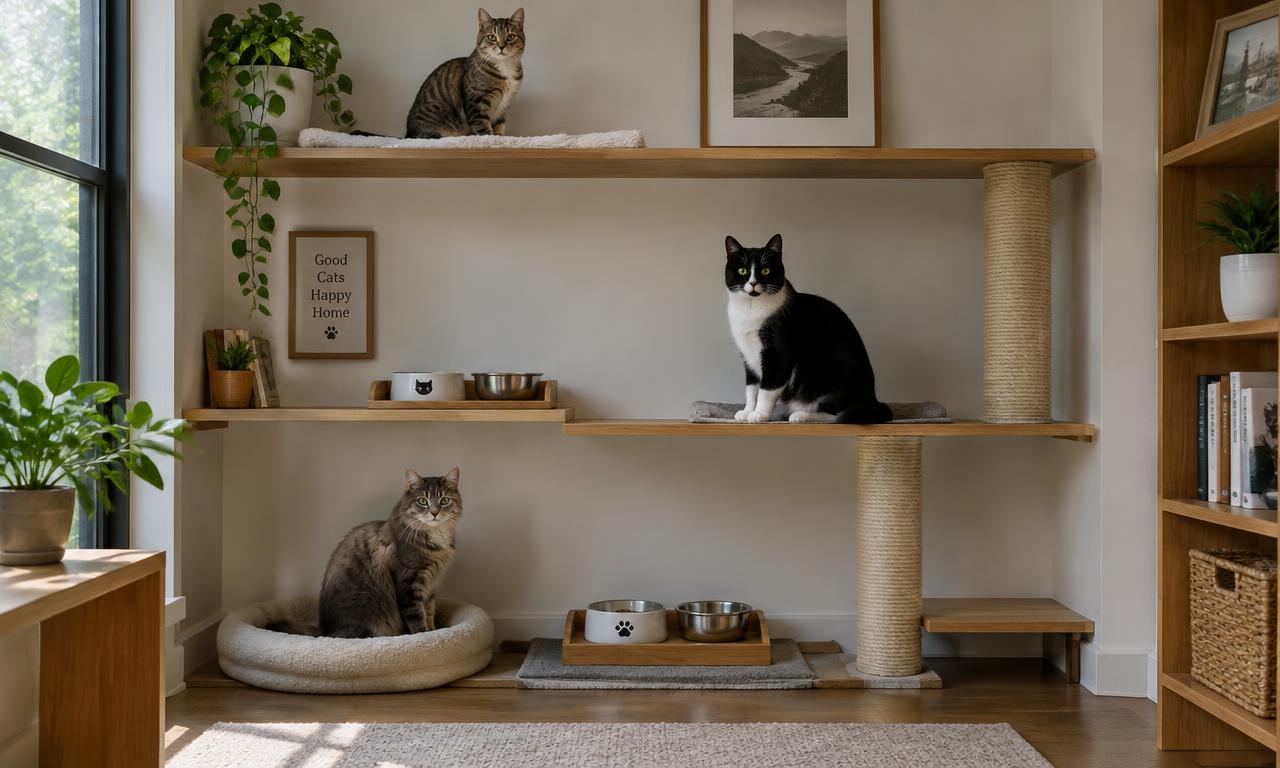
AI-generated editorial image; illustrative, not a clinical demonstration or documentary photograph.
Practical decisions at a glance
| Situation | Safer next step |
|---|---|
| Several cats | Check each animal’s actual access, not only resource counts. |
| Different diets | Observe individual meals and keep a backup plan. |
| One-sided chasing | Provide safe separation and assess the pattern. |
| Change after illness | Review health and reintroduce cautiously if needed. |
Use the individual animal’s needs and responses; this is educational guidance, not a diagnosis or a guaranteed outcome.
Distinguish tolerance from friendship
Cats sharing a home do not necessarily form one social group. Relaxed mutual grooming and voluntary resting together can suggest affiliation, while blocking doorways, staring, chasing or one cat always hiding may indicate conflict. An absence of fights does not prove every cat has comfortable access to resources.
Observe each cat separately: where it rests, eats and toilets, and whether its movements change when another cat appears. New withdrawal, house-soiling or aggression needs a veterinary assessment as well as an environmental review. Pain can change relationships and tolerance of contact.
Spread resources rather than creating one station
Provide multiple accessible feeding, drinking, toileting, scratching and resting options in distinct locations. Placing several bowls together may still let one cat control them all. Ensure an older or less mobile cat can reach its own resources without stairs or confrontation.
Offer hides and elevated resting places with safe access. Where possible provide more than one exit from important areas so a cat cannot easily be cornered. Avoid moving every familiar resource at once; maintain predictable choices while testing changes.
Feed and play without competition
Separate meals if cats rush, steal food or have different dietary needs. Watch actual intake rather than assuming an empty shared bowl means everyone ate. A microchip feeder can help some households but needs gradual introduction, maintenance and a backup if it fails.
Offer individual play opportunities, using toys appropriate to the cat and avoiding crowding cats around one reward. Let each cat choose participation and retain quiet rest. Chasing a housemate is not automatically enjoyable play when the recipient repeatedly escapes or cannot disengage.
Handle introductions and conflict gradually
New arrivals should begin in a prepared separate area. Gradual scent exchange and controlled visual contact are appropriate only while the animals remain comfortable. Do not force nose-to-nose meetings or leave them to fight it out. Progress depends on responses, not a fixed number of days.
If a fight occurs, avoid reaching between the cats. Create separation safely and allow calm recovery, then seek advice on reintroduction. Persistent tension, injury, food restriction or fear warrants help from a veterinarian and a qualified feline behaviour professional. Some households need lasting separation or a different placement to protect welfare.
Map resources from each cat’s perspective
Walk through the home imagining the route each cat actually takes. A feeding station may be inaccessible when another cat rests in the doorway; several trays in one corner may function as a single blocked resource. Spread useful choices through separate locations and consider mobility, noise and sight lines. Keep at least some options away from the other cats’ usual resting places. Do not remove a familiar tray just because a new one has been added. Watch whether the less confident cat starts using an area voluntarily rather than assuming the extra equipment solved the problem.
Make individual feeding visible
When diets differ, feed in appropriately separated areas and observe each animal’s intake. Record leftovers or a new reluctance to approach instead of treating an empty shared dish as proof all cats ate. Introduce a selective feeder gradually if used, checking that it opens reliably and the cat is comfortable entering. Another cat may still wait nearby or steal food after access, so placement matters. Keep a manual backup and a caregiver who can assess appetite directly. Prescribed diets, weight changes or repeated vomiting need veterinary input rather than a feeder adjustment alone.
Recognise conflict without provoking a demonstration
Avoid deliberately bringing cats together to see whether they fight. Instead observe ordinary routes, resting, grooming, play and toileting. A cat that freezes, hides or delays eating may be experiencing pressure without visible attack. Look for whether chasing is mutual and whether either cat can disengage; repeated one-sided pursuit is not automatically a game. Sudden irritability can relate to pain or illness. Separate safely after escalation and seek help, rather than punishing one cat or using water sprays that may worsen the association with its housemate.
Plan for visitors, illness and change
Household relationships can shift after a clinic visit, a new animal, building work or changes in mobility. Preserve quiet areas and familiar resources while offering space to avoid unfamiliar smells or activity. A returning cat may need a calm separate recovery area according to veterinary instructions. Keep feeding and medication records separate so care changes do not lead to mistakes. If tension persists, obtain a veterinarian’s assessment and qualified feline behaviour support. Lasting protected separation or a carefully supported alternative home may be appropriate when comfortable coexistence cannot be achieved.
- Review each cat’s food, litter and rest access separately.
- Do not require shared bowls or forced contact as proof of harmony.
Frequently asked questions
- Are several bowls together several resources?
- Not necessarily. One cat can control access to the whole station; location and routes matter.
- Does no fighting mean every cat is comfortable?
- No. Blocking, hiding and inhibited eating can show tension without a fight.
- Should cats share food to bond?
- Do not force sharing. Comfortable individual feeding is more important than proximity.
- Can a relationship change after illness?
- Yes. Review pain, scents, mobility and access, and seek help with persistent conflict.
References
- Introducing cats — Cats Protection
- Feline environmental needs guidelines — AAFP/ISFM