
Dog training
Teaching a Reliable Recall
Recall is the most valuable behaviour you will ever teach, and the one most commonly poisoned by accident.
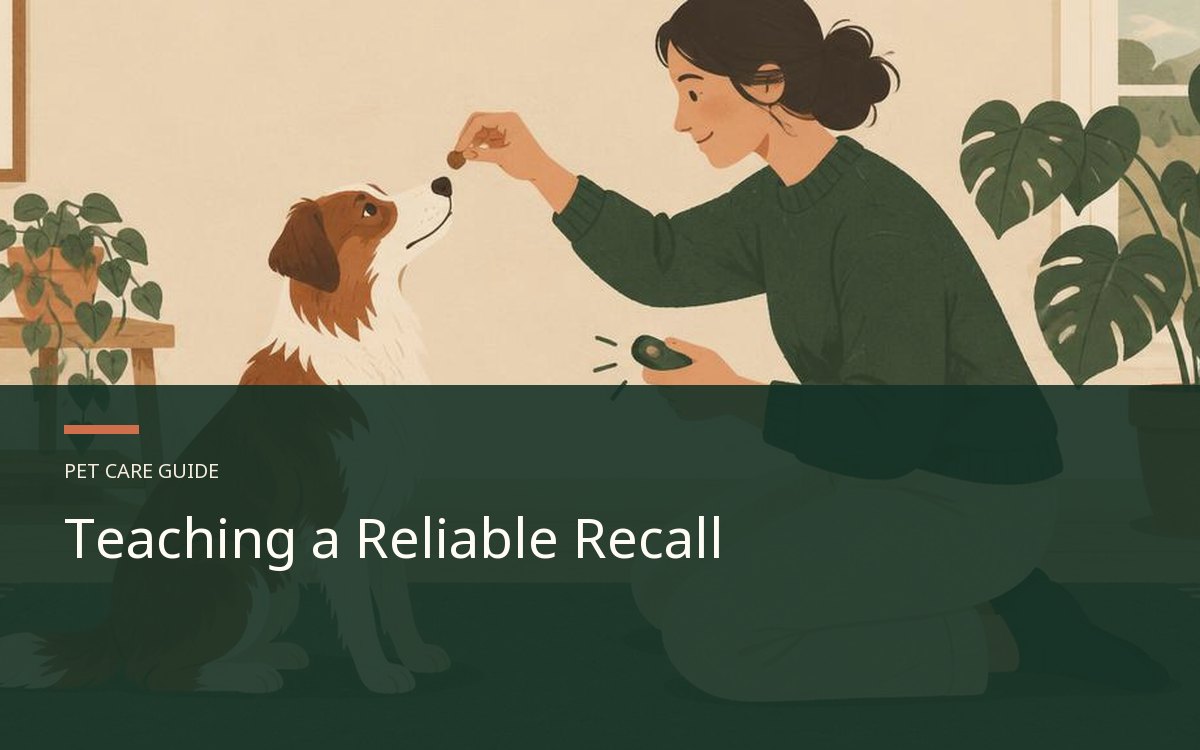
Illustrative cover using relevant category imagery; it does not depict the exact subject.
Practical decisions at a glance
| Situation | Safer next step |
|---|---|
| High consequence of failure | Use a lead or secure enclosure. |
| Arrival | Reward close return and practise gentle handling. |
| Missed response | Reduce difficulty instead of repeating louder. |
| Several caregivers | Use one agreed cue and safety routine. |
Use the individual animal’s needs and responses; this is educational guidance, not a diagnosis or a guaranteed outcome.
Start with an easy response
Recall is a trained behaviour, not a guarantee that a dog will respond in every situation. Start indoors or in a quiet enclosed space when the dog is nearby and not absorbed in something else. Say the cue once in a cheerful, consistent tone, then reward the dog for turning and coming close. Make arriving worthwhile with food, play or social interaction that the individual dog values. Never call to punish, scold or end every enjoyable activity.
Choose a clear cue and strong reward
Choose a cue that is not already repeated constantly without success. Practise a few easy responses and reward generously. If the dog does not respond, avoid repeating the word louder; reduce distraction, move closer or use a long line in a safe area. Use a distinct emergency cue only with careful practice and a particularly valuable reward. Keep rewards appropriate to the dog’s diet and health, and account for them in daily feeding.
Increase difficulty in small steps
Build difficulty gradually: distance, duration and distraction should not all rise at once. Practise in different safe locations because a response learned at home may not transfer automatically to a park. Use a secure enclosed area or a long line attached to suitable equipment until the dog is dependable in that context. Avoid off-lead practice near roads, livestock, wildlife or other hazards. A long line needs careful handling to prevent tangling or injury.
Protect safety during practice
When the dog comes, reward the return and sometimes release it to resume exploring if safe. This teaches that recall does not always end freedom. Do not chase a dog that is playing keep-away; use calm movement, a familiar game or safe management and seek help if needed. If the dog is frightened or injured, approach carefully. A reliable recall still requires barriers, leads and supervision whenever consequences of failure could be serious.
Prevent the cue becoming background noise
If responses weaken, review whether the cue has been overused, rewards are inadequate or practice is too difficult. Return to easier settings and rebuild reinforcement rather than blaming the dog. Family members should use the same cue and avoid calling when they cannot follow through safely. Keep sessions brief and enjoyable, stop before frustration rises, and revisit training as the dog matures or environments change. For persistent chasing or escape behaviour, consult a qualified reward-based trainer.
Additional practical considerations
Practise with a helper when appropriate: one person gently holds the dog in a safe enclosed place while the other calls and rewards, then swap roles. Avoid restraint that frightens or frustrates the dog. The exercise should feel easy and celebratory, not like a test. If the dog is reluctant, shorten the distance and improve the reward. Progress depends on the dog’s comfort and attention, not on completing a fixed number of repetitions.
Make sure the dog’s identification and contact details are current, and use secure gates and fencing as backup. Recall training is only one part of preventing loss. A dog that has escaped should not be punished when recovered; calm return and immediate safety matter most. For dogs with strong chasing or fear responses, plan routes and equipment with a qualified professional rather than repeatedly exposing the dog to situations it cannot yet manage.
Everyday follow-through
Keep rewards meaningful and practise where the dog can succeed. Avoid calling when the dog is overwhelmed or absorbed in an unsafe distraction. If a cue predicts unpleasant events, choose a fresh cue and rebuild positively. A qualified trainer can help with strong chasing or escape behaviour.
Separate training distance from safety distance
Use a secure enclosed place or a suitable long line when a missed response could lead to traffic, wildlife conflict or a lost dog. Check attachment points, footing and other people before beginning. Do not attach a long line in a way that allows a sudden stop to jerk the neck, and never wrap it around fingers or allow it to tangle around legs. Keep distance manageable so the line is not a substitute for paying attention. Ask a reward-based trainer to demonstrate handling if the dog is strong or likely to accelerate suddenly.
Make arrival worth repeating
Reward reaching you, not only the first turn of the head, and practise a comfortable collar or harness touch before releasing the dog again where safe. This helps avoid a pattern of arriving almost within reach and moving away when handling begins. Choose rewards that genuinely matter to this dog and account for edible rewards in its diet. Avoid using the cue for punishment, uncomfortable grooming or ending every enjoyable outing. Sometimes reward and release back to exploration so returning does not always predict loss of access to the environment.
Respond to a missed cue without escalating
If the dog does not come, avoid repeating the word until it becomes background noise. Reduce distraction, approach safely or guide with the existing management arrangement without hauling or frightening it. Review whether the task was too difficult, the reward was weak or the dog was worried. Return to a setting with reliable easy responses. A dog absorbed in chasing may be unable to perform at the level trained indoors. Do not test the next attempt off lead to prove improvement; keep physical safety measures while skills are rebuilt.
Rehearse with everyone who walks the dog
Agree the cue, reward and safe release routine across caregivers. Practise brief successful sessions in several safe locations, changing one challenge at a time rather than increasing distance and distraction together. Adolescence, pain or a frightening experience can change responses. Seek veterinary advice for an abrupt behavioural change and professional training help for persistent chasing or escape. Even excellent training cannot guarantee a response in every situation. Leads, barriers and respect for local access rules remain necessary when failure would put animals, people or wildlife at risk.
- Do not test recall near roads or livestock.
- Never call a returning dog to punish it.
Frequently asked questions
- Can reliable recall replace a lead near roads?
- No. The consequence of one failure is too serious; use physical safety measures.
- Should I keep repeating the cue?
- No. Make the task easier and rebuild the response instead of turning the word into background noise.
- Should every recall end the walk?
- Not necessarily. Where safe, reward and sometimes release to exploration so returning stays worthwhile.
- What if the dog suddenly stops responding?
- Review health, fear and context; seek advice and keep secure management rather than testing off lead.
References
- Dog advice and training — Dogs Trust