
Coat care
Deshedding Double-Coated Dogs: Why You Should Never Shave Them
How undercoat blowing works, the right tools and routine, and why clipping a husky or a collie down for summer usually backfires.
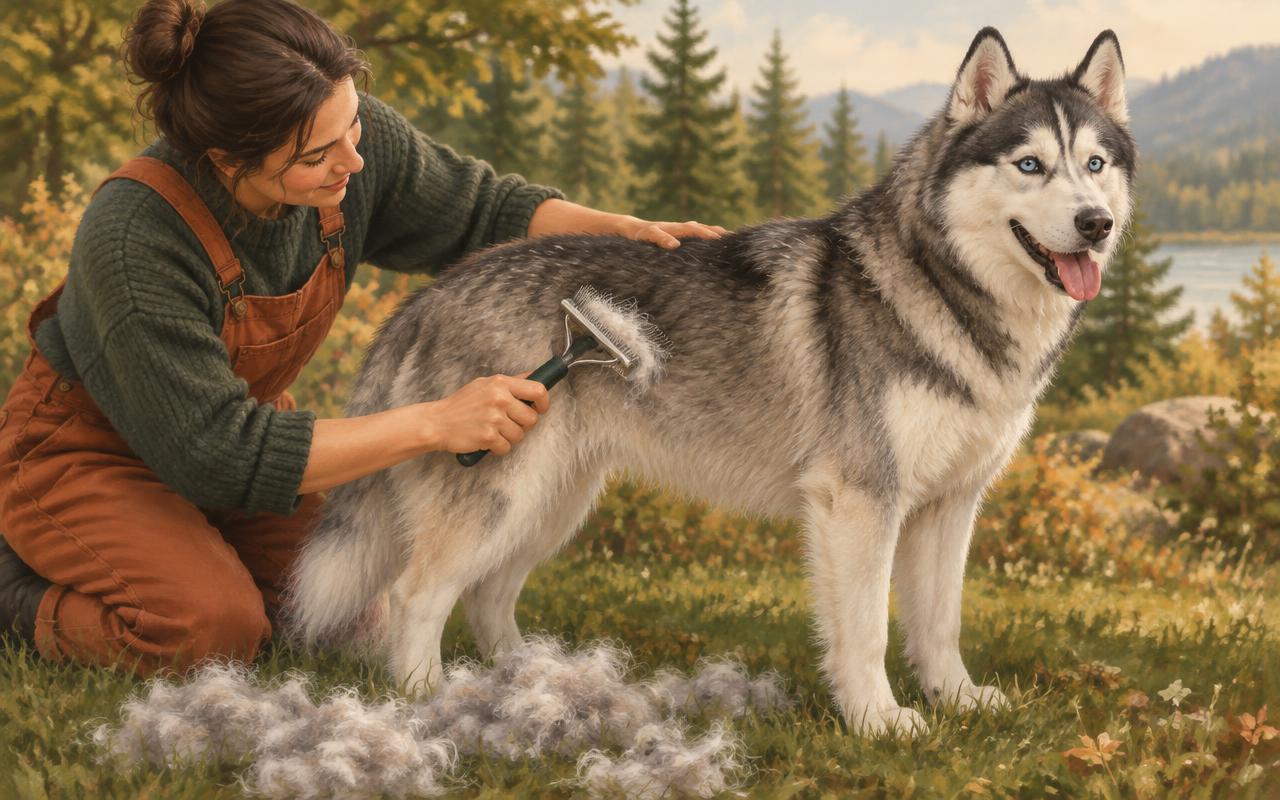
AI-generated editorial illustration of the subject; not a photograph of a specific animal, product or case.
What a double coat actually is
Breeds like huskies, German shepherds, collies, Samoyeds and many retrievers carry two distinct coat layers: a coarser, weather-resistant outer coat of guard hairs, and a dense, insulating undercoat of soft fur close to the skin. The undercoat traps air to keep the dog warm in winter and, counterintuitively, also helps regulate body temperature and block solar heat in summer, which is why this coat type is so effective across a wide range of climates.
Twice a year, usually with seasonal day-length changes rather than temperature alone, these dogs 'blow' their undercoat, shedding large amounts of loose fur over a few weeks as the old undercoat is pushed out and replaced. This is a normal, healthy process, not a sign of a skin problem, though dogs kept mostly indoors under artificial light can shed more continuously and less predictably.
Why shaving a double coat usually backfires
It is tempting to think clipping a husky or collie down to the skin in summer will keep them cooler, but the undercoat and guard hairs work together as insulation against heat as well as cold, and removing them can leave a dog more vulnerable to sunburn and overheating, not less. The two coat layers also do not always grow back evenly after shaving; some dogs develop patchy, altered regrowth, and in rarer cases the coat does not fully return to its original texture.
The effective way to help a double-coated dog manage warm weather is thorough deshedding to remove loose undercoat, access to shade and fresh water, and avoiding exercise during the hottest part of the day, rather than cutting the coat itself short.
Tools and technique for deshedding
A slicker brush or pin brush can move surface tangles, but the tools that actually remove loose undercoat efficiently are an undercoat rake and a grooming tool designed to catch the fine undercoat without cutting the guard hairs. Brushing in the direction of hair growth, working in sections, and being thorough along the flanks, neck ruff and hindquarters (areas with the densest undercoat) makes the biggest difference during a heavy shed.
Bathing partway through a heavy shed, followed by thorough drying with a blow dryer on a cool or warm setting while brushing, can loosen and remove large amounts of dead undercoat in a single session, which many owners find more effective during a 'coat blow' than dry brushing alone.
Building a sustainable routine
Outside of the twice-yearly heavy shed, a regular brushing routine, commonly a few sessions a week, keeps loose hair from building up, reduces matting, and gives an owner a chance to check the skin underneath for lumps, parasites or irritation that might otherwise go unnoticed under a dense coat. During peak shedding periods, daily brushing for a shorter session is often more manageable than longer, infrequent sessions.
Diet and overall health also affect coat quality and shedding volume; a dog on an unsuitable diet, carrying excess weight, or dealing with an underlying health issue may shed more heavily or have a dull, flaky coat, so persistent excessive shedding outside the normal seasonal pattern is worth mentioning at a vet visit rather than assuming it is purely cosmetic.
Matting and the areas that need special attention
Double coats are prone to matting where the undercoat is thickest and friction is highest: behind the ears, in the armpits, around the collar area, and at the base of the tail. Mats trap moisture and debris against the skin and can become painful or lead to skin infection if left unaddressed, so checking these spots regularly, even when the rest of the coat looks fine, prevents small tangles becoming a bigger grooming problem.
A mat that cannot be worked out gently with fingers and a comb is better removed by a groomer with appropriate clippers than tugged at length, since matted fur pulled against the skin causes real discomfort; in dogs with severe, widespread matting a professional groomer may need to shave affected areas for welfare reasons, which is a different situation from routine seasonal coat shaving.
Frequently asked questions
- Will shaving my husky or collie keep them cooler in summer?
- Usually not; the double coat provides insulation against heat as well as cold, and shaving can increase the risk of sunburn and does not reliably reduce heat stress. Thorough deshedding and shade are generally more effective.
- How often should I brush a double-coated dog?
- A few sessions a week outside of the seasonal shed is typical, increasing to daily shorter sessions during the heavy 'coat blow' periods in spring and autumn.
- Is heavy shedding a sign something is wrong?
- Seasonal shedding in large amounts is normal for double-coated breeds. Shedding that is unusually excessive, patchy, or accompanied by skin irritation outside the normal pattern is worth a vet check.
- What tool actually removes undercoat rather than just the top layer?
- An undercoat rake or a tool specifically designed to pull loose undercoat is more effective than a standard slicker brush alone, especially during heavy seasonal shedding.
References
- Grooming and coat care advice — PDSA
- Dog care advice — Dogs Trust
- Pet owner resources — AVMA
- Pet health library — VCA Animal Hospitals