
Enrichment
Enrichment and Puzzle Feeders
Foraging and play equipment can support natural behaviour when matched to the species, individual abilities and safe materials. No toy guarantees a feeding duration or treats a behaviour problem on its own.
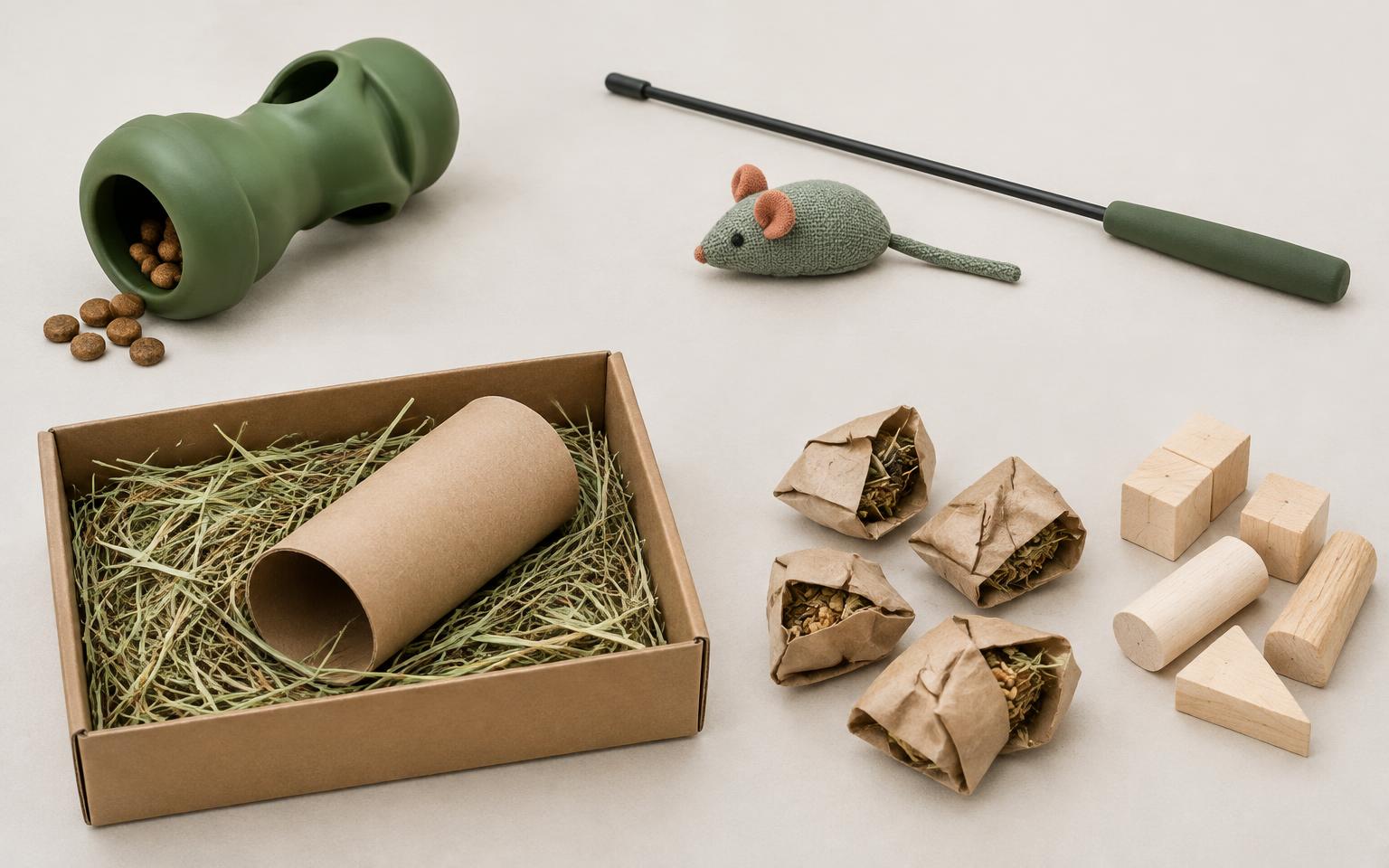
AI-generated editorial illustration; not a clinical demonstration or documentary photograph.
What matters
- Adjustable difficulty
- Animals give up on puzzles that are too hard at the first attempt.
- Material safety
- Hard plastics crack and splinter; check for swallowable parts on every use.
- Cleanability
- Food-contact parts must be accessible for thorough cleaning using the maker’s instructions; dishwasher use is suitable only when specified.
- Species-appropriate action
- Dogs like licking and rolling, cats like batting and hunting, parrots like shredding and unwrapping.
- Durability
- No material is chew-proof. Observe the individual and remove equipment when it develops swallowable pieces or unsafe openings.
Types and options
Stuffable food toy
Best for: Suitable dogs during observed introduction and calm food activities
Watch out: Count food in the daily allowance; it is not automatically safe to leave unattended
Slow-feeder bowl
Best for: Fast eaters and deep-chested breeds
Watch out: Not a bloat prevention guarantee
Snuffle mat
Best for: Supervised scent-led foraging for dogs that do not ingest the fabric
Watch out: Remove if chewing or ingestion occurs; a hay-based foraging tray may better suit rabbits
Foraging toys for parrots
Best for: Species-appropriate manipulation and food-search opportunities
Watch out: Check materials and attachments; feather damage needs veterinary assessment, not a toy-only treatment
Buying notes
Introduce easy tasks and preserve reliable feeding, familiar retreats and rest. Rotate optional activities according to the animal’s response rather than a fixed number of toys. Stop if a task causes fear, frustration, guarding or unsafe chewing.
Choose an activity, then check its risks
| Animal or task | Check before use |
|---|---|
| Dog food toy | Size, breakage, cleaning access and actual chewing behaviour. |
| Cat interactive play | Supervised string use, no detachable hazards, and put the wand away afterwards. |
| Rabbit foraging | Appropriate hay and materials; avoid swallowed fabric or unsafe packaging. |
| Bird manipulation | Species-safe materials and attachments; retain clear movement space. |
| Any food puzzle | Start easy, maintain intake and count the normal food allowance. |
Illustrated equipment is not a tested product recommendation. No toy is universally safe or a treatment for unexplained behaviour changes.
Choose a purpose before a product
Start with an activity the animal can perform safely: investigating food, chasing a suitable play object, shredding appropriate material, digging or exploring. Watch what the individual already chooses and which opportunities are missing. A complex puzzle is not automatically better than a simple foraging tray, and an animal does not need to complete a difficult task to deserve its normal meal. Enrichment equipment cannot replace appropriate housing, rest, social care or a medically suitable diet. Persistent distress or a sudden behaviour change needs assessment rather than another purchase.
- Keep reliable food and water access available.
- Preserve familiar hiding and resting places.
- Let the animal leave or decline the activity.
Match materials and movement to the species
For dogs, choose equipment that cannot easily lodge in the mouth or break into swallowable pieces under that individual's play style. Cats may enjoy hunting-style interactive play, but put away string and wand toys after supervised use. Rabbits can use suitable hay-based foraging opportunities and safe cardboard when they do not ingest problematic amounts; fabric mats are unsuitable when eaten. Birds need suitable materials, safe attachments and room to move without obstruction. Species labels are a starting point, not a guarantee that every item is safe for every animal.
Inspect openings, attachments and damage
Look for gaps that could trap a jaw, head, claw or limb, loose strands that can entangle, and detachable parts that may be swallowed. Examine seams, fasteners, wood, rubber and plastic before use and after vigorous play. No claim of toughness makes equipment indestructible. Remove exposed stuffing, splintering material, sharp edges and damaged components rather than waiting for the next cleaning day. Avoid improvised repairs to a part whose failure creates an entrapment or ingestion risk. Ask an experienced species professional when you cannot assess a material or attachment.
Introduce the easiest version while observing
Show accessible food or a simple action first, in a quiet place where the animal can approach voluntarily. Increase difficulty only when it remains interested and comfortable. Repeated frustrated biting, freezing, fleeing or abandoning food may mean the task needs changing. Do not withhold the regular meal to force persistence. Count food used in equipment in the appropriate daily allowance and check compatibility with a prescribed diet. Separate animals when competition or guarding affects access. A first successful session does not establish that an item is safe during a long unattended absence.
Clean food equipment without leaving hidden residue
Choose designs that can be opened or reached sufficiently to remove food from every contact surface. Follow the maker's cleaning instructions; dishwasher use is appropriate only when specified, and hand-cleanable equipment can also be suitable. Clean food-contact equipment after use, especially when it holds moist food, and dry it fully before storage. Inspect hidden channels for residue rather than judging only the outer surface. Discard items that cannot be cleaned reliably or have developed cracks and inaccessible damaged areas. Keep cleaning products away from the animal and rinse as directed.
Review welfare rather than counting toys
Observe voluntary engagement, comfortable movement, normal intake and the ability to stop. Rotate optional objects if variety helps, but leave trusted retreats and essential resources predictable. More objects can obstruct routes or create competition rather than improve welfare. If an animal suddenly chews unfamiliar things, over-grooms, damages feathers, eats less or becomes distressed, consult a veterinarian about medical and behavioural causes. Do not assume boredom or treat a toy as therapy for an undiagnosed problem. Adapt activities after illness or as mobility changes, and seek appropriately qualified behaviour support where needed.
Common questions
- Is a tougher toy always safe to leave unattended?
- No. Observe actual use and inspect damage; a durability claim does not rule out ingestion or entrapment.
- Must food toys be dishwasher-safe?
- No. They must be thoroughly cleanable by a suitable method. Use a dishwasher only if the maker permits it.
- Can a snuffle mat be given to every rabbit?
- No. Fabric ingestion is a risk. Appropriate hay-based foraging and suitable materials may be a safer choice.
- Can enrichment prevent every feather or behaviour problem?
- No. These problems can have medical and other causes. Seek veterinary assessment instead of relying on toys alone.
Sources for this guide
- Blue Cross: how to play with your dog
- RSPCA: rabbit enrichment and toys
- RSPCA: bird enrichment
- AAFP/ISFM feline environmental needs guidelines
AI-assisted educational guidance, updated 2026-10-19. Not professionally reviewed; sources do not imply endorsement.