
Independent guide · Updated 2026-10-20
Scratching posts and surfaces
Stable vertical and horizontal scratching options that support stretching, claw care and scent marking.
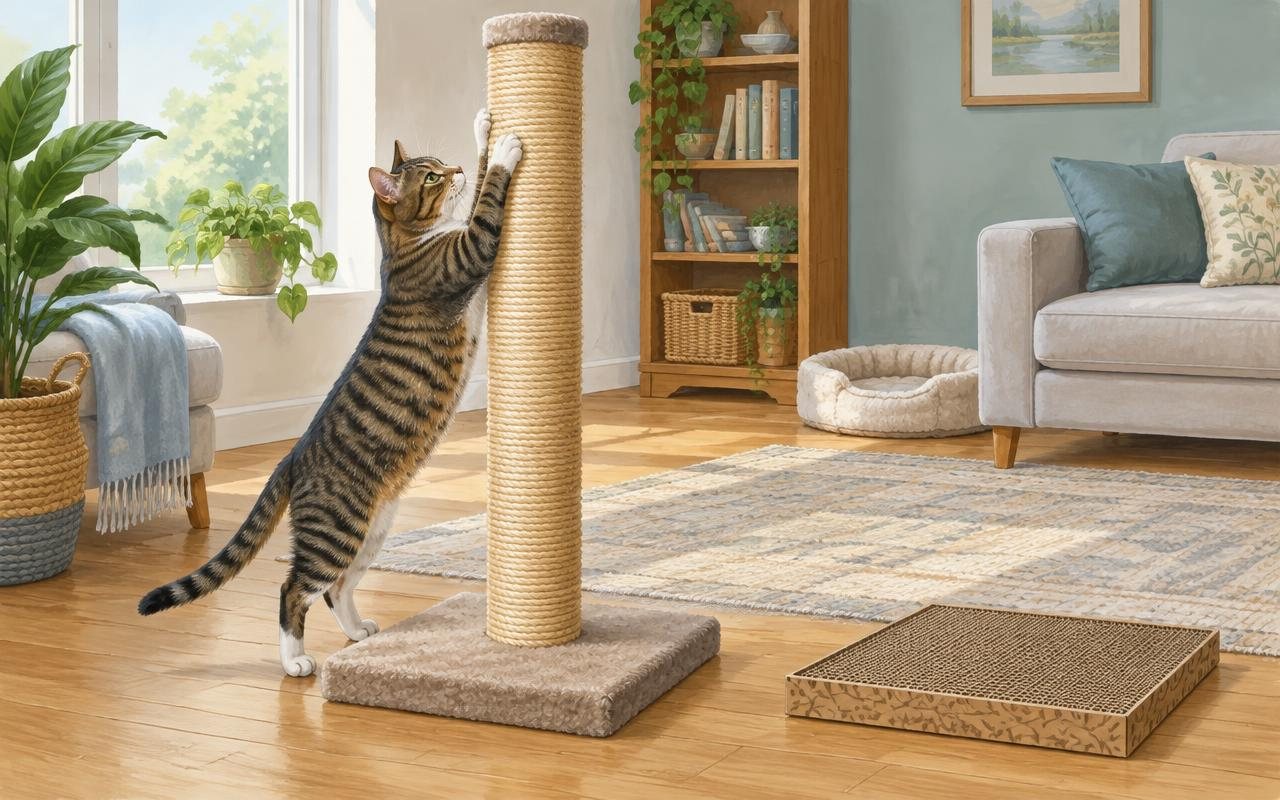
AI-generated editorial illustration; not a clinical demonstration or documentary photograph.
What to look for
- Stability
- The base must resist tipping during a full-body pull.
- Texture
- Sisal, cardboard and wood offer different feedback; individual preference matters.
- Placement
- Put surfaces near sleeping areas, routes and existing scratch locations.
Sizing and fit
A vertical post should be tall enough for the cat to stretch fully with forelegs extended.
Safety checks
- Check staples, loose fibres and wobbling joints.
- Do not punish scratching or forcibly place paws on a post.
- Offer horizontal options for cats that prefer them.
Cleaning and maintenance
Trim dangerous loose strands and replace unstable or heavily shredded sections while retaining familiar options.
Why a cat may ignore a scratching surface
| Possible mismatch | What to try |
|---|---|
| Wobbling or sliding | Stabilise or replace before encouraging use. |
| Too short for a stretch | Offer adequate usable length. |
| Wrong orientation or texture | Provide an alternative while retaining a familiar option. |
| Inaccessible location | Place resources near useful routes and rest areas. |
| New pain or gait change | Seek veterinary assessment rather than forcing use. |
Scratching is normal. Resource changes support welfare; punishment and forced paw placement do not teach comfortable use.
Treat scratching as normal behaviour
Cats scratch to maintain claws, stretch and leave visual and scent signals. A suitable surface gives this behaviour an acceptable outlet; it does not remove the need to scratch. Watch where and how the cat already scratches before buying. Some prefer vertical stretch, others work horizontally or at an angle, and texture preferences differ. Start with more than one usable option when preference is unclear. Do not punish scratching, spray the cat with water or force its paws against a post. These responses can increase fear without showing the animal a comfortable alternative.
Test stability and usable length
A vertical post needs enough usable surface for the individual to stretch with extended forelegs. Measure the actual scratching area rather than total decorative height. Check stability under a pull in several directions: a wobbling base can discourage use or create a fall risk. Horizontal pads should resist sliding while allowing a natural stance. Wall-mounted designs need suitable secure fixings and checks appropriate to the wall and product. For a cat with limited mobility, easy floor-level options may be preferable to a climbing structure. New movement difficulty still needs assessment rather than being treated only as a product preference.
- Check joints, fixings and the base before use.
- Offer the cat's preferred orientation where possible.
- Keep approaches clear and comfortably accessible.
Place resources where the behaviour happens
A post hidden in an unused room may be less useful than one near a sleeping area, route or established scratching location. Place a suitable alternative beside the currently used furniture while protecting the furniture with a safe non-harmful barrier where appropriate. Do not remove every familiar scratch surface abruptly. In multi-cat homes, spread resources so another cat cannot block all access. Consider whether the route passes a dog's resting area or a busy doorway. The aim is a convenient safe choice in the cat's territory, not a single object placed where it is easiest for people to ignore.
Introduce choices without forced handling
Allow investigation and reward voluntary interest or use. Suitable play near the resource may encourage exploration, but do not lure a cat into an unstable climb or unsafe position. Catnip affects some cats and not others; it is optional and cannot compensate for poor dimensions, material or placement. If a new surface is ignored, change one variable at a time and keep an existing acceptable option available. Avoid scented deterrents or essential oils that could expose pets to hazards. A behaviour plan should consider household stress and resource access rather than treating every furniture scratch as disobedience.
Replace hazards while retaining useful familiarity
Inspect staples, loose strands, exposed fittings and worn attachments regularly. Frayed material can entangle claws, and broken joints can collapse during a full-body pull. Replace unsafe parts promptly, but place a new safe option nearby when possible so the cat is not left without a familiar behaviour outlet. Follow the manufacturer's cleaning instructions and avoid saturating porous structures that cannot dry properly. More structures are not always better if they crowd routes or create contested high points. Changes in scratching, claw appearance, gait or sensitivity need veterinary advice, particularly when they appear suddenly or alongside other behaviour changes.
Common questions
- Why does my cat use the sofa but not its post?
- Check stability, usable length, texture, orientation and location. Offer a suitable alternative near the existing scratching site.
- Should I move my cat's paws over the post?
- No. Let the cat investigate voluntarily and reward comfortable use without forced handling.
- Is one post enough for a multi-cat household?
- Not necessarily. Spread accessible resources so another cat cannot block every option.
- Should I keep a badly frayed favourite post?
- Remove entanglement or structural hazards. Introduce a safe replacement nearby when possible to preserve choice and familiarity.
Sources for this guide
AI-assisted educational guidance, updated 2026-10-20. Not professionally reviewed; sources do not imply endorsement.
A practical purchase and first-use check
- Match scratching posts and surfaces to the listed species (Cats), the individual animal and the actual task. A product's marketing claim is not proof it meets those needs.
- Before ordering, verify fit: A vertical post should be tall enough for the cat to stretch fully with forelegs extended. Check the return policy if safe fitting cannot be established from measurements.
- Introduce new equipment gradually and watch how your animal behaves around it. Check it cannot trap, burn, injure or be chewed into a hazard, and stop using it if it causes distress.
- Plan the ongoing upkeep: Trim dangerous loose strands and replace unstable or heavily shredded sections while retaining familiar options. Include replacement parts and safe disposal, not only the initial price.
Educational reference, not an individual diagnosis or a verified professional review. Read our editorial policy.
Guidance libraries and further reading
These organisations publish relevant guidance. Their links are further reading, not evidence that they have reviewed this page.
- PDSA — veterinary charity pet health advice
- RSPCA — animal care and welfare advice across species
- International Cat Care — cat health, behaviour and welfare advice