
Independent guide · Updated 2026-10-20
Puzzle feeders and enrichment toys
Food-delivery enrichment matched to skill level, chewing strength and the ability to clean it properly.
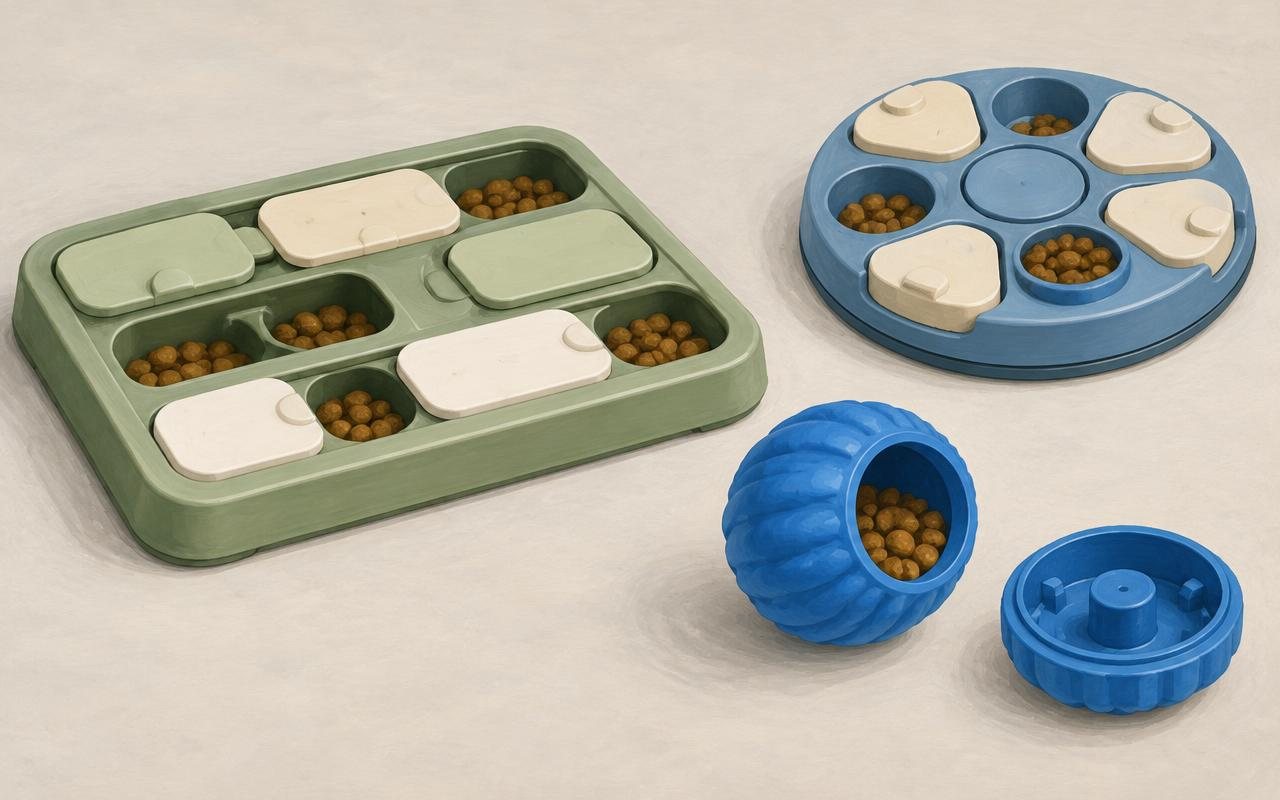
AI-generated editorial illustration; not a clinical demonstration or documentary photograph.
What to look for
- Difficulty
- Begin with easy access and adapt the task to comfortable voluntary engagement.
- Durability
- Inspect materials and detachable parts for the individual's chewing and manipulation style; no toy is indestructible.
- Cleanability
- Every food-contact surface must be reachable for reliable cleaning; dishwasher use is suitable only when specified.
Sizing and fit
Assess jaw, head, tongue, toe and claw entrapment as well as swallowing risk for the actual individual; no universal opening measurement guarantees safety.
Safety checks
- Supervise introduction and reassess safety before any unattended use.
- Discard cracked or chewed-through items.
- Never use rings or handles an animal can trap a jaw or limb in.
Cleaning and maintenance
Clean food-contact parts after use, especially with moist food, following material-specific instructions; dry fully and inspect each time.
Puzzle feeding: keep welfare ahead of difficulty
| Check | Good starting point |
|---|---|
| Access | Food is easy to obtain; normal feeding remains reliable. |
| Safety | No entrapment, swallowable parts or destructive use. |
| Diet | Use appropriate food within the feeding plan. |
| Response | Voluntary comfortable engagement, not repeated frustration. |
| Cleaning | Every food-contact cavity can be cleaned and dried. |
Puzzles are optional enrichment, not medical treatments or a reason to withhold an essential diet.
Choose an achievable feeding activity
Food enrichment can provide exploration and problem-solving opportunities when it suits the individual. Begin with food that is easy to see and reach, rather than making an animal solve a complicated mechanism for its normal meal. Dogs, cats, birds and small mammals manipulate objects differently, so a generic pet label cannot establish suitability. An animal recovering from illness, with impaired mobility or on a prescribed diet may need a simpler arrangement agreed with the veterinary team. Keep ordinary reliable feeding access available while learning. Declining a puzzle is a reason to review the activity, not to withhold food until the animal complies.
Check openings and detachable components
Assess whether the individual can trap its jaw, head, tongue, toes or claws, not only whether the whole toy fits in its mouth. Different openings can be dangerous in different ways; there is no universal safe hole measurement across species. Look for pieces that can break free, sharp edges and material that the animal tends to swallow. A product advertised as tough is not indestructible. Supervise introduction and remove damaged parts immediately. Homemade options need the same inspection as bought equipment, including adhesives, staples and coatings. When suitability is uncertain, ask someone experienced with that species rather than relying on a photograph.
- Inspect before and after each session.
- Avoid improvised repairs that create new traps.
- Stop use if the animal destroys rather than safely manipulates it.
Keep the feeding plan intact
Count food used in puzzles in the animal's appropriate daily allowance. Treats should not displace the essential balanced or prescribed diet. Check that the selected food and toy are suitable for that diet, including texture and storage needs. For herbivores, enrichment must not restrict essential forage access; a puzzle is not a reason to ration normal hay inappropriately. Observe who eats in a multi-pet home and separate sessions when stealing, guarding or intimidation occurs. A puzzle may slow access to food but cannot guarantee prevention of bloat, weight loss or another medical outcome. Review actual intake rather than assuming that an emptied toy means the intended animal ate.
Adjust difficulty from behaviour, not a schedule
Watch for voluntary approach, comfortable manipulation and the ability to stop. Repeated frustrated biting, leaving food, freezing or guarding suggests the task or setting needs changing. Make food more accessible, reduce moving parts or choose another activity. Progress only when the current version is easy and comfortable. Do not leave a newly successful toy unattended simply because one short session went well. Sessions should suit the animal's energy and normal routine, not a fixed universal duration. An optional activity should add useful choice without reducing rest, normal food access or positive social contact.
Clean inside and reassess over time
Choose equipment that can be opened or reached sufficiently to remove every food residue. Clean after use, especially with moist food, follow material-specific instructions and dry fully before storage. Dishwasher compatibility is useful when stated but is not essential if reliable hand cleaning is possible. Check seals and inner cavities rather than only the visible exterior. Retire cracked items and inaccessible damaged channels. As chewing style, teeth, health or mobility change, an old favourite may become unsafe or too difficult. New reluctance to eat, mouth sensitivity or weight change needs veterinary assessment rather than a harder puzzle or more tempting treats.
Common questions
- Should I withhold a meal until my pet solves a puzzle?
- No. Keep reliable feeding access and make the activity easy enough for comfortable voluntary use.
- Is a large toy automatically safe?
- No. Openings, detachable parts, material and individual chewing behaviour can create hazards regardless of overall size.
- Can puzzle feeding prevent bloat?
- Do not treat it as guaranteed prevention of gastric dilatation-volvulus or another medical condition.
- Can I share one puzzle between several animals?
- Only if safe access and compatibility are established. Separate sessions when competition, stealing or guarding affects welfare.
Sources for this guide
AI-assisted educational guidance, updated 2026-10-20. Not professionally reviewed; sources do not imply endorsement.
A practical purchase and first-use check
- Match puzzle feeders and enrichment toys to the listed species (Dogs, Cats, Small mammals, Birds), the individual animal and the actual task. A product's marketing claim is not proof it meets those needs.
- Before ordering, verify fit: Assess jaw, head, tongue, toe and claw entrapment as well as swallowing risk for the actual individual; no universal opening measurement guarantees safety. Check the return policy if safe fitting cannot be established from measurements.
- Introduce new equipment gradually and watch how your animal behaves around it. Check it cannot trap, burn, injure or be chewed into a hazard, and stop using it if it causes distress.
- Plan the ongoing upkeep: Clean food-contact parts after use, especially with moist food, following material-specific instructions; dry fully and inspect each time. Include replacement parts and safe disposal, not only the initial price.
Educational reference, not an individual diagnosis or a verified professional review. Read our editorial policy.
Guidance libraries and further reading
These organisations publish relevant guidance. Their links are further reading, not evidence that they have reviewed this page.
- PDSA — veterinary charity pet health advice
- RSPCA — animal care and welfare advice across species
- International Cat Care — cat health, behaviour and welfare advice