
Astronotus ocellatus
Oscar
The oscar is a large, intelligent South American cichlid that recognises its keepers and can live over ten years. It needs a big, powerfully filtered aquarium and is not a community fish.
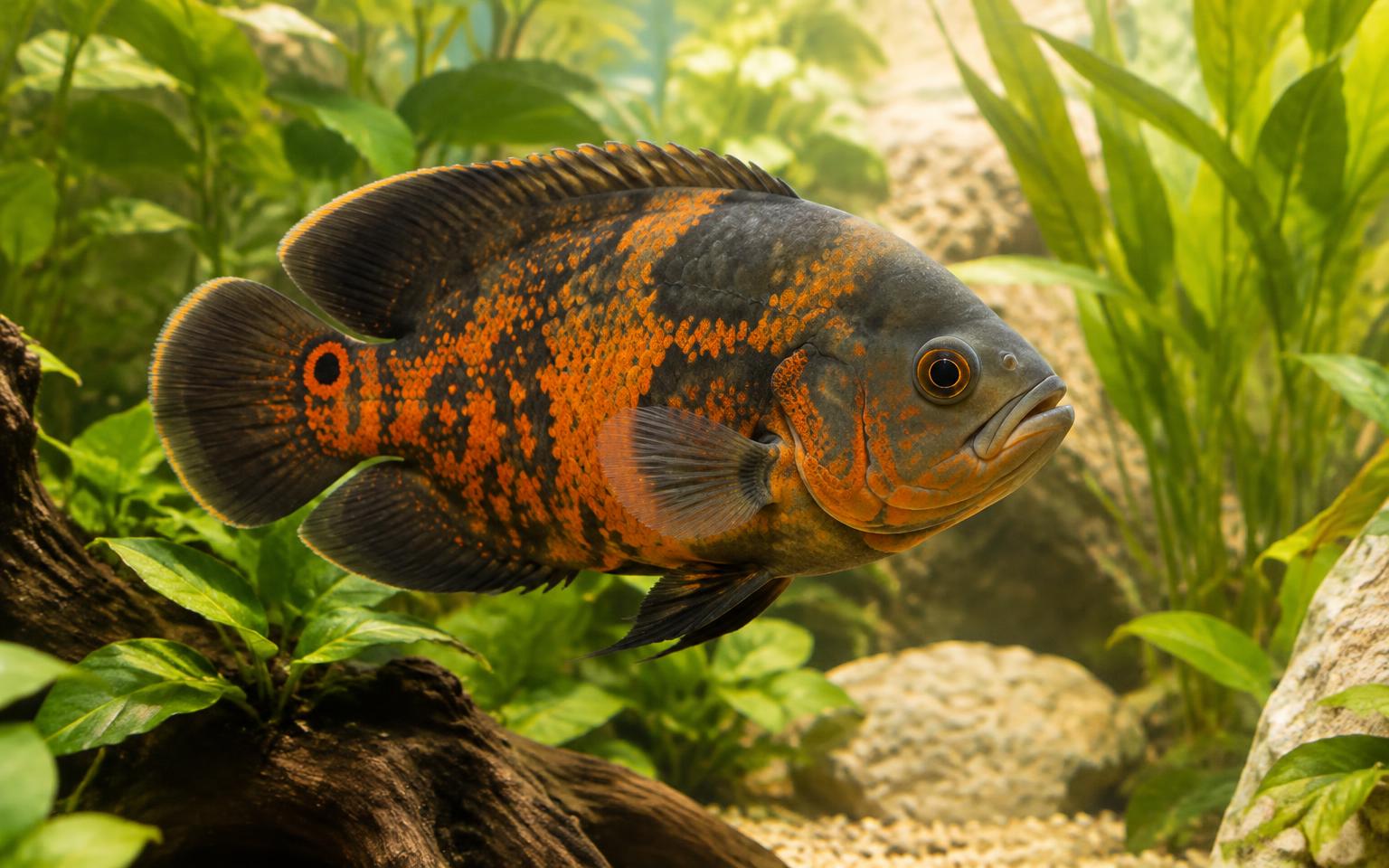
Illustrative cover using relevant category imagery; it does not depict the exact subject.
At a glance
- Scientific name
- Astronotus ocellatus
- Family
- Cichlidae
- Origin
- Amazon basin, South America
- Lifespan
- 10–15 years
- Adult size
- 25–35 cm
- Weight
- Up to 1.5 kg
- Temperament
- Intelligent and interactive for a fish, but territorial and predatory.
- Activity level
- Moderate; active swimmer that rearranges décor.
- Social needs
- Often kept singly; tank mates must be large, robust and chosen carefully.
- Intelligence
- High for a fish; recognises owners and learns feeding routines.
- Noise
- Silent.
Housing and environment
- Housing
- Minimum about 285 litres (75 US gallons) for one adult, with heavy filtration and a secure lid.
- Space requirement
- A large, sturdy aquarium on a load-bearing surface.
- Temperature
- 24–28 °C.
- Humidity
- Not applicable.
- Exercise
- Needs swimming space more than enrichment.
- Grooming
- Not applicable; depends on excellent water quality.
Life stages and changing needs
Expanded care guidance · Updated 7 October 2026 · Not professionally reviewed
Young animals and settling in
A young oscar is typically a few centimetres long but grows quickly into a large, heavy-bodied fish, so the eventual tank size must be planned before purchase rather than upgraded repeatedly as the fish outgrows each home. Juveniles can often be kept alongside similarly sized tankmates, but this tolerance is temporary. Cycle the aquarium fully before any fish arrive, and introduce a young oscar to established, mature filtration rather than a freshly set-up tank.
Adult care and reproductive changes
A full-grown oscar can reach around thirty centimetres and needs a large, well-filtered aquarium, commonly recommended at minimum around seventy-five gallons or more for one adult, since this species produces a lot of waste and reshapes its tank by digging and uprooting plants and decor. Adults can become territorial, especially a mated pair, and may injure smaller or slower tankmates; secure the lid well since oscars are capable jumpers, and protect heaters and intake tubes from being rammed or dug out.
Later life and changing needs
A well-kept oscar can live ten to thirteen years or longer. An older fish should retain a steady appetite, upright swimming and clear eyes; the species is prone to hole-in-the-head disease, which can show as pits or erosion around the head and lateral line and is linked to water quality and nutrition. Clamped fins, reduced appetite, cloudy eyes or new lumps are not a normal part of ageing and warrant water testing and an aquatic-vet opinion.
Diet and feeding
Carnivorous: quality cichlid pellets plus frozen foods; avoid feeder fish, which spread disease.
Feed a varied diet based on good-quality cichlid pellets, supplemented with appropriate frozen or live foods; oscars are opportunistic predators in the wild and will eat flakes, pellets, frozen and live foods, including other fish small enough to swallow, so do not house them with small tankmates intended as permanent companions. Avoid a diet based solely on feeder fish, since these can carry disease and rarely supply balanced nutrition.
Feed amounts that are cleared within a few minutes once or twice daily, and watch body condition rather than encouraging begging behaviour at every approach to the tank, which this species is known for. Overfeeding combined with poor filtration is a major contributor to the water-quality problems linked to hole-in-the-head disease, so match feeding to a robust maintenance routine rather than increasing portions whenever the fish approaches the glass.
Daily care and ongoing checks
Every day
Check filtration, temperature and water clarity daily, since this large, messy fish fouls water quickly and needs strong mechanical and biological filtration, ideally a canister filter, to stay healthy. Inspect decor and equipment for damage, since oscars frequently rearrange gravel, uproot plants and bump into heaters and intake tubes.
Regular maintenance and prevention
Carry out regular partial water changes guided by test results and the heavy bioload this species produces; a once-weekly routine is a starting point, not a fixed rule, for a well-stocked oscar tank. Watch for pitting around the head and lateral line, cloudy eyes, clamped fins or reduced appetite, and quarantine any new tankmates before introduction.
Behaviour and compatibility
Digs, moves ornaments and can sulk after tank changes; aggressive to smaller fish.
- With children
- Fine as a display fish; children should not put hands in the tank unsupervised.
- With other animals
- Will eat any fish that fits in its mouth.
- Training difficulty
- Can learn simple feeding cues.
Health
- Hole-in-the-head disease
- Ich
- Bloat from poor diet
- Ammonia poisoning in undersized tanks
Most problems trace back to water quality; test weekly and change 25–30% of the water weekly.
Special care requirements
See the housing, diet and health sections — this species has needs that are easy to underestimate.
Large-tank planning and heavy filtration
An oscar purchased as a small juvenile will outgrow a standard community tank within its first year, so plan for an aquarium of at least roughly seventy-five gallons or more from the outset rather than upgrading repeatedly. This species is known for recognising its keeper and begging at feeding time, which can tempt overfeeding; match portions to body condition rather than enthusiasm.
Oscars dig, uproot plants and can damage equipment, so use secured, heavy decor and well-protected heaters and intake tubes. Watch closely for pitting around the head and lateral line, since hole-in-the-head disease is relatively common in this species and is linked to water quality and nutrition rather than being an inevitable part of keeping oscars.
Before you take one on
Sources and further guidance
These welfare and veterinary resources inform general husbandry advice; they do not certify this profile or replace a species-experienced professional. Confirm exact environmental settings and feeding plans for your animal.
Can your home meet oscar needs?
- Plan for a lifespan of 10–15 years, including holiday cover and, where one is available, a vet familiar with this species. Lifespan ranges are not guarantees.
- Arrange the social setting before arrival. Social guidance for this species: Often kept singly; tank mates must be large, robust and chosen carefully. Do not assume another animal of any species is a suitable companion.
- Habitat priority for this species: A large, sturdy aquarium on a load-bearing surface. Make sure your setup can provide this consistently. Check temperature and water quality with a thermometer and test kits rather than guessing.
- Key care point: See the housing, diet and health sections — this species has needs that are easy to underestimate. Discuss diet and any specialist needs with the supplier, rescue and a vet who treats this species, and check local legal requirements before acquiring an animal.
Educational reference, not an individual diagnosis or a verified professional review. Read our editorial policy.
Guidance libraries and further reading
These organisations publish relevant guidance. Their links are further reading, not evidence that they have reviewed this page.