
Paracheirodon innesi
Neon Tetra
Neon tetras are the classic beginner shoaling fish, bringing constant movement and colour to a modest, well-cycled community tank. Their main risk is disease introduced with poor-quality stock rather than any husbandry difficulty of their own.
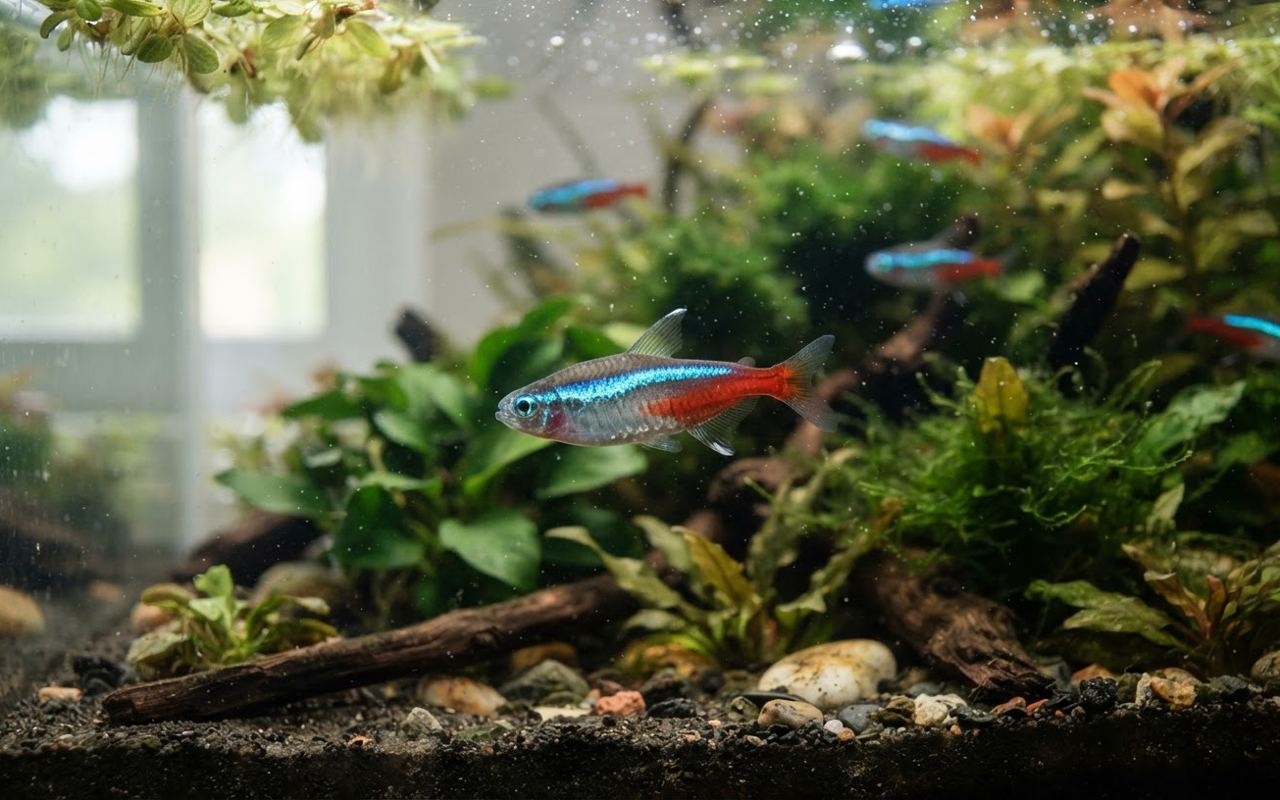
AI-generated editorial illustration of the subject; not a photograph of a specific animal, product or case.
At a glance
- Scientific name
- Paracheirodon innesi
- Family
- Characidae
- Origin
- Clear and blackwater tributaries of the upper Amazon basin
- Lifespan
- 5–8 years with stable water quality
- Adult size
- 2.5–4 cm
- Weight
- Not typically measured
- Temperament
- Peaceful, active shoaling fish
- Activity level
- High; constant mid-water movement in a group
- Social needs
- High; must be kept in shoals of at least eight to feel secure and show natural colour
- Intelligence
- Simple shoaling and feeding-response behaviour
- Noise
- Silent
Housing and environment
- Housing
- Densely planted aquarium of at least 60 litres with gentle filtration
- Space requirement
- Horizontal swimming length more valuable than depth
- Temperature
- 20–26°C
- Humidity
- Not applicable, aquatic species
- Exercise
- Provided by tank length and shoal interaction
- Grooming
- Not applicable
Life stages and changing needs
Expanded care guidance · Updated 7 October 2026 · Not professionally reviewed
Young animals and settling in
Small schooling fish such as neon tetras must be introduced in a full shoal from the outset, since a handful bought to “start small” will show stress colouration, hiding and poor appetite until the group is large enough to feel secure. Only add fish to a fully cycled tank, acclimatise slowly to avoid temperature and chemistry shock, and source from a reputable supplier, since these small species are particularly vulnerable to disease introduced with poor-quality stock.
Adult care and reproductive changes
Adults should remain in a stable shoal of at least the recommended minimum number, since reducing the group through deaths or rehoming can trigger renewed stress and fin-nipping among the remainder. These fish will breed opportunistically in a well-planted tank, but eggs and fry are usually eaten by tankmates without intervention; dedicated breeding requires a separate, specifically prepared tank and is not necessary for the fish's welfare.
Later life and changing needs
With stable water quality these fish can live for several years, well beyond the single season some keepers expect from a “cheap” starter fish. There is no distinct senior stage to manage; instead, watch condition, colour and shoaling behaviour over time. A fish separating from the group, losing colour or swimming abnormally needs water testing and close observation rather than being assumed to be simply old.
Diet and feeding
Small flake or micro-pellet food plus occasional live or frozen daphnia and brine shrimp
Offer small flake or micro-pellet food sized for a small mouth, with occasional live or frozen foods such as daphnia or brine shrimp for variety. Particles that are too large go uneaten and foul the water rather than being eaten later. Feed small amounts once or twice daily and watch that timid individuals at the back of the shoal are actually reaching food, not just the fastest fish at the front.
Avoid overfeeding, which is a common cause of poor water quality in small, heavily stocked community tanks. Remove uneaten food after a few minutes. A sudden drop in group appetite should prompt a water test for ammonia, nitrite and temperature before assuming illness, since small fish are highly sensitive to even brief chemistry swings.
Daily care and ongoing checks
Every day
Check filtration, heater function, temperature and the behaviour of the whole shoal every day; a cohesive, actively swimming group is a good general welfare sign, while scattering, clamped fins or fish hovering near the surface warrant closer inspection. Keep the tank decorated with planting or cover that lets timid fish retreat from boisterous tankmates.
Regular maintenance and prevention
Carry out regular partial water changes based on test results and stocking density, always treating new water for chlorine or chloramine before it is added. Quarantine newly purchased fish separately for several weeks, since introducing a single infected fish can rapidly spread disease through an established, densely stocked shoal.
Behaviour and compatibility
Tight shoaling, mid-water cruising, brief chasing during feeding
- With children
- Good beginner community fish for supervised feeding and observation
- With other animals
- Compatible with other small peaceful community fish; avoid larger predatory species
- Training difficulty
- Not applicable
Health
- Neon tetra disease (an incurable microsporidian infection)
- Ich
- Fin rot from poor water quality
No individual veterinary treatment is realistic; prevention is through quarantine and stable water parameters
Special care requirements
Buy from a reputable source, as neon tetra disease can wipe out an established shoal and is untreatable
Shoal size and disease-free sourcing
Neon tetras must be kept in a shoal of at least eight; smaller groups show visible stress through faded colour, hiding and poor appetite, since this is a schooling species whose sense of security depends on shoal size rather than any single tankmate or decoration.
Buy from a reputable, quarantine-conscious supplier, since incurable neon tetra disease can be introduced with a single poor-quality fish and spread through an entire established shoal; quarantine every new tetra separately for several weeks before adding it to your main tank regardless of how healthy it appears.
Before you take one on
Sources and further guidance
These welfare and veterinary resources inform general husbandry advice; they do not certify this profile or replace a species-experienced professional. Confirm exact environmental settings and feeding plans for your animal.
Can your home meet neon tetra needs?
- Plan for a lifespan of 5–8 years with stable water quality, including holiday cover and, where one is available, a vet familiar with this species. Lifespan ranges are not guarantees.
- Arrange the social setting before arrival. Social guidance for this species: High; must be kept in shoals of at least eight to feel secure and show natural colour. Do not assume another animal of any species is a suitable companion.
- Habitat priority for this species: Horizontal swimming length more valuable than depth. Make sure your setup can provide this consistently. Check temperature and water quality with a thermometer and test kits rather than guessing.
- Key care point: Buy from a reputable source, as neon tetra disease can wipe out an established shoal and is untreatable. Discuss diet and any specialist needs with the supplier, rescue and a vet who treats this species, and check local legal requirements before acquiring an animal.
Educational reference, not an individual diagnosis or a verified professional review. Read our editorial policy.
Guidance libraries and further reading
These organisations publish relevant guidance. Their links are further reading, not evidence that they have reviewed this page.